

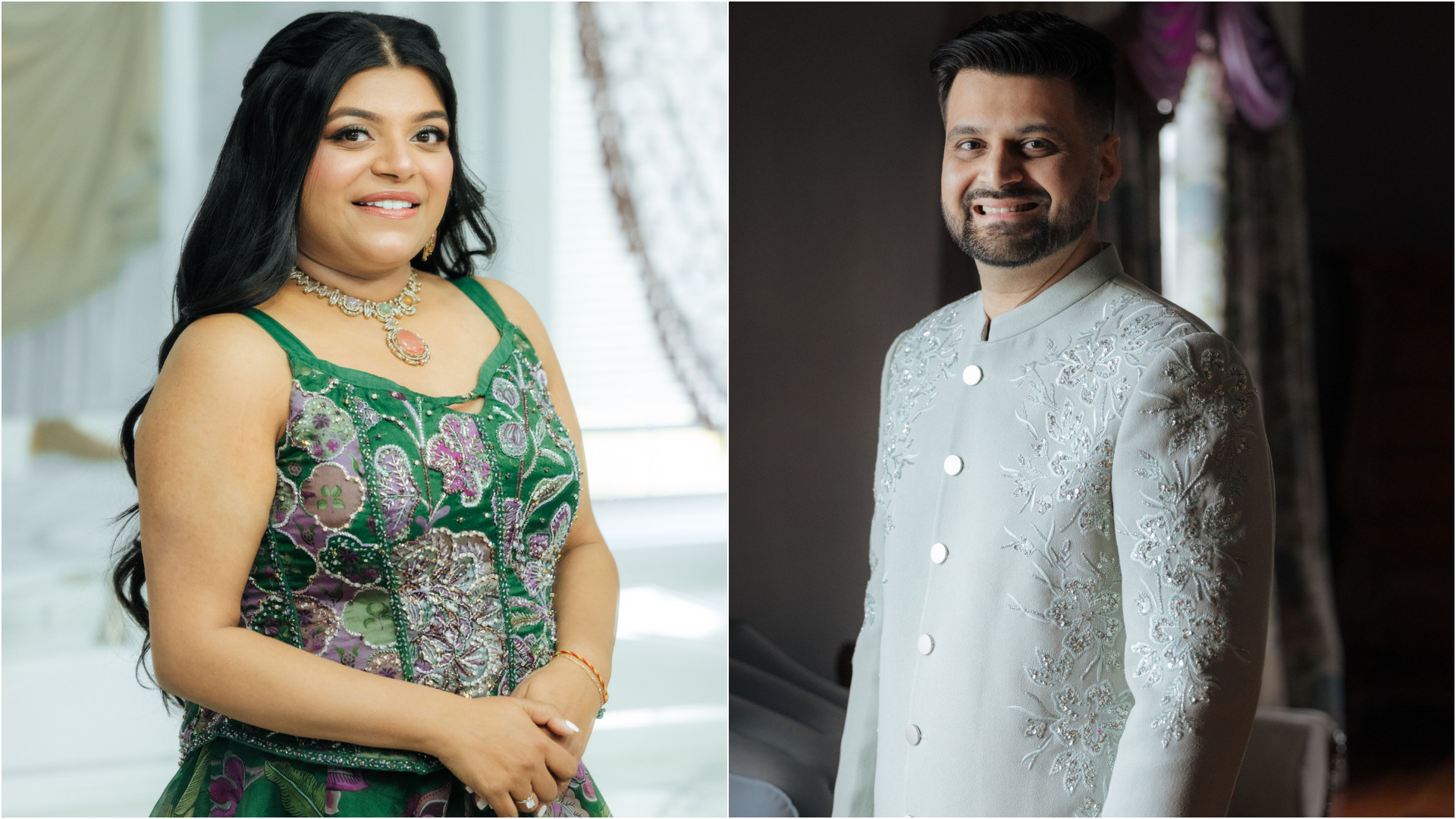
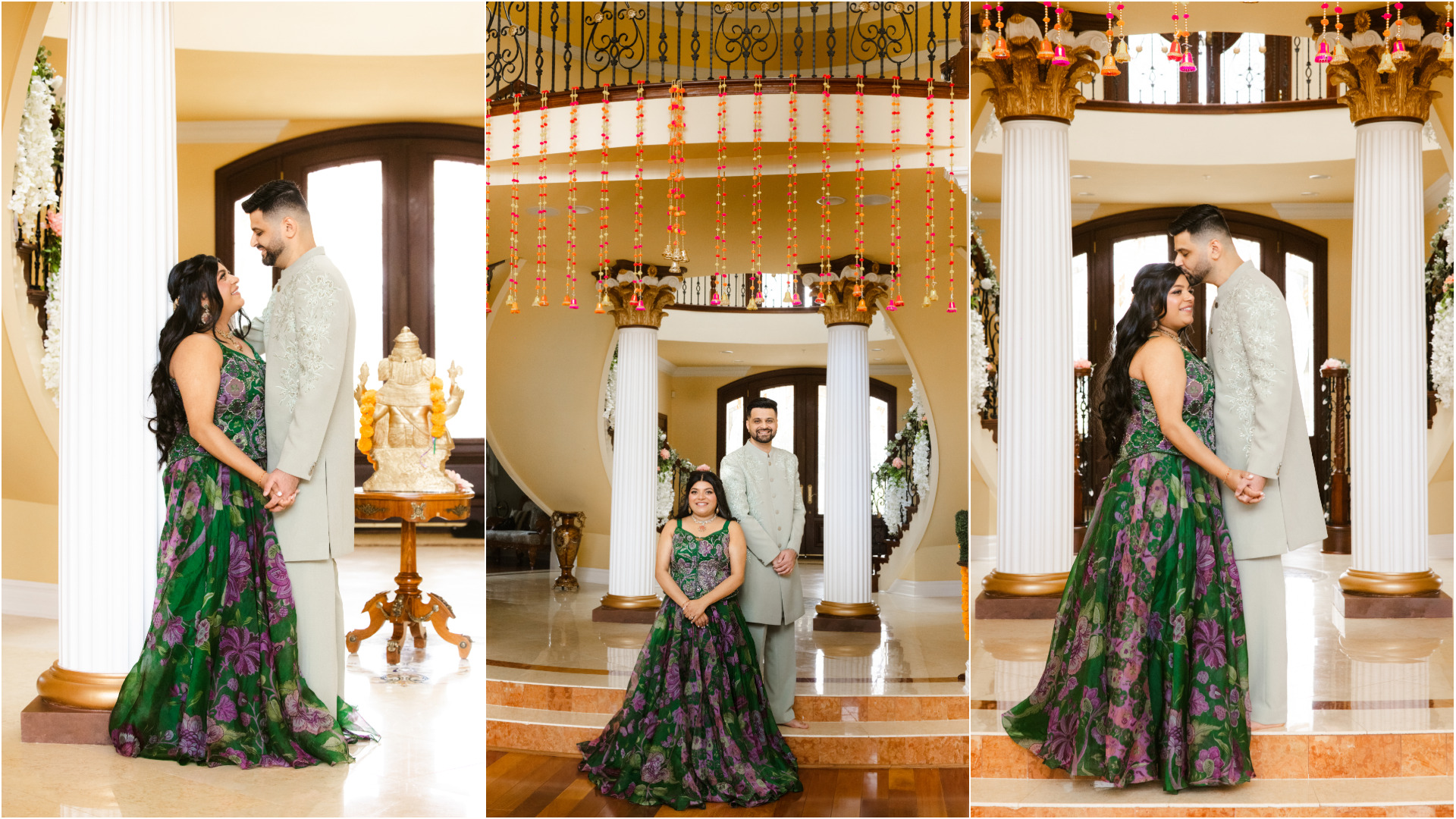
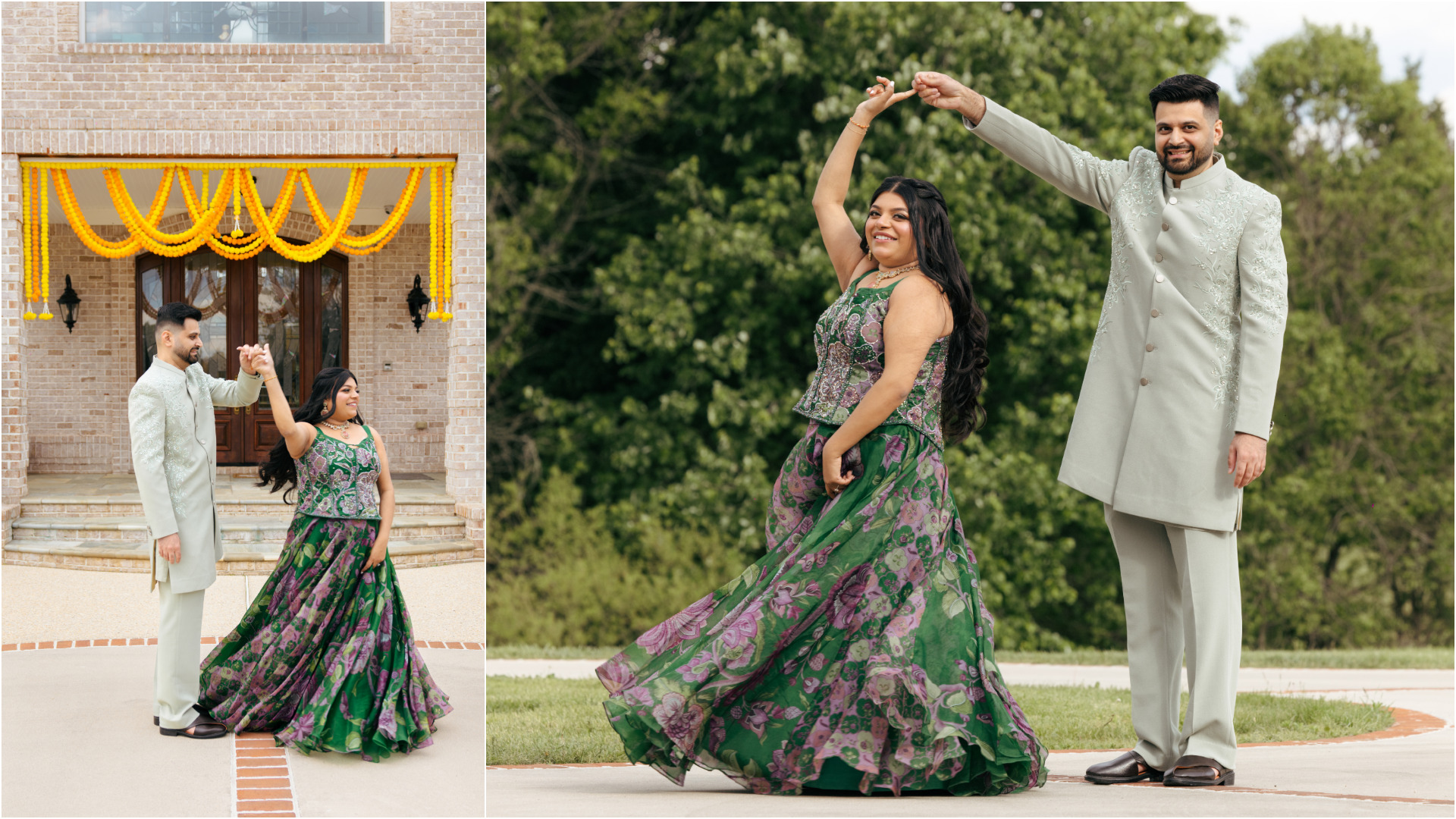
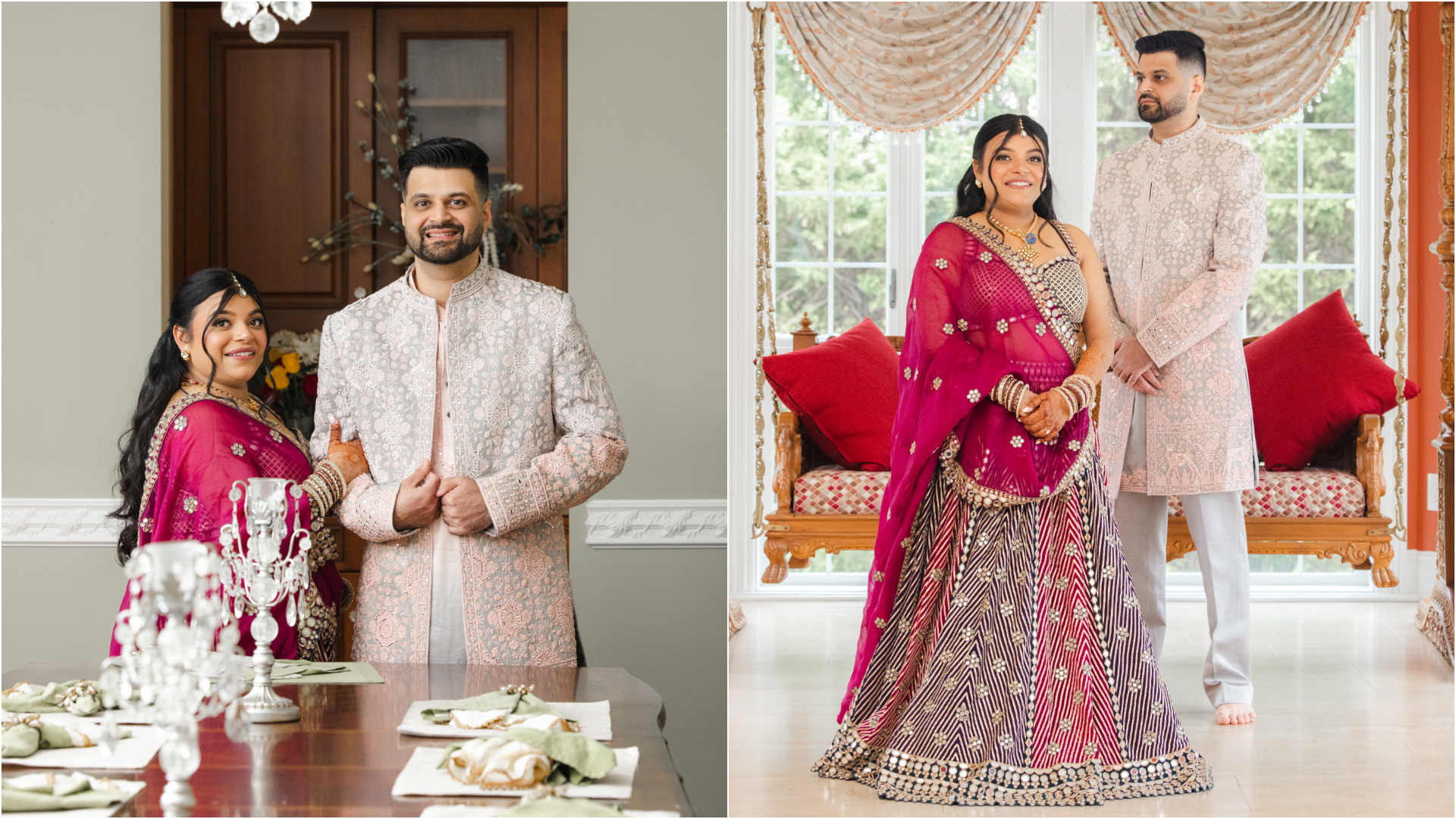
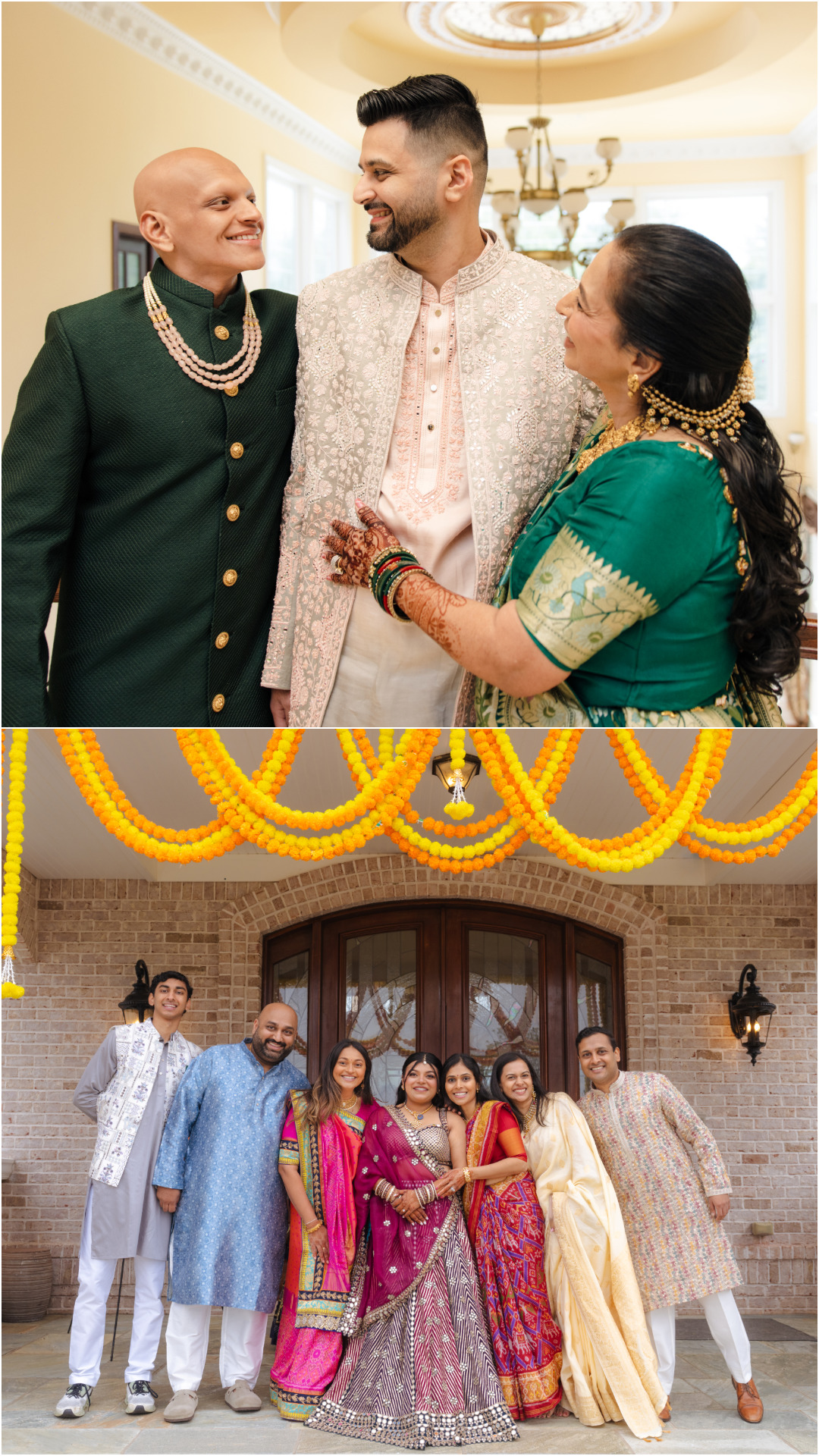
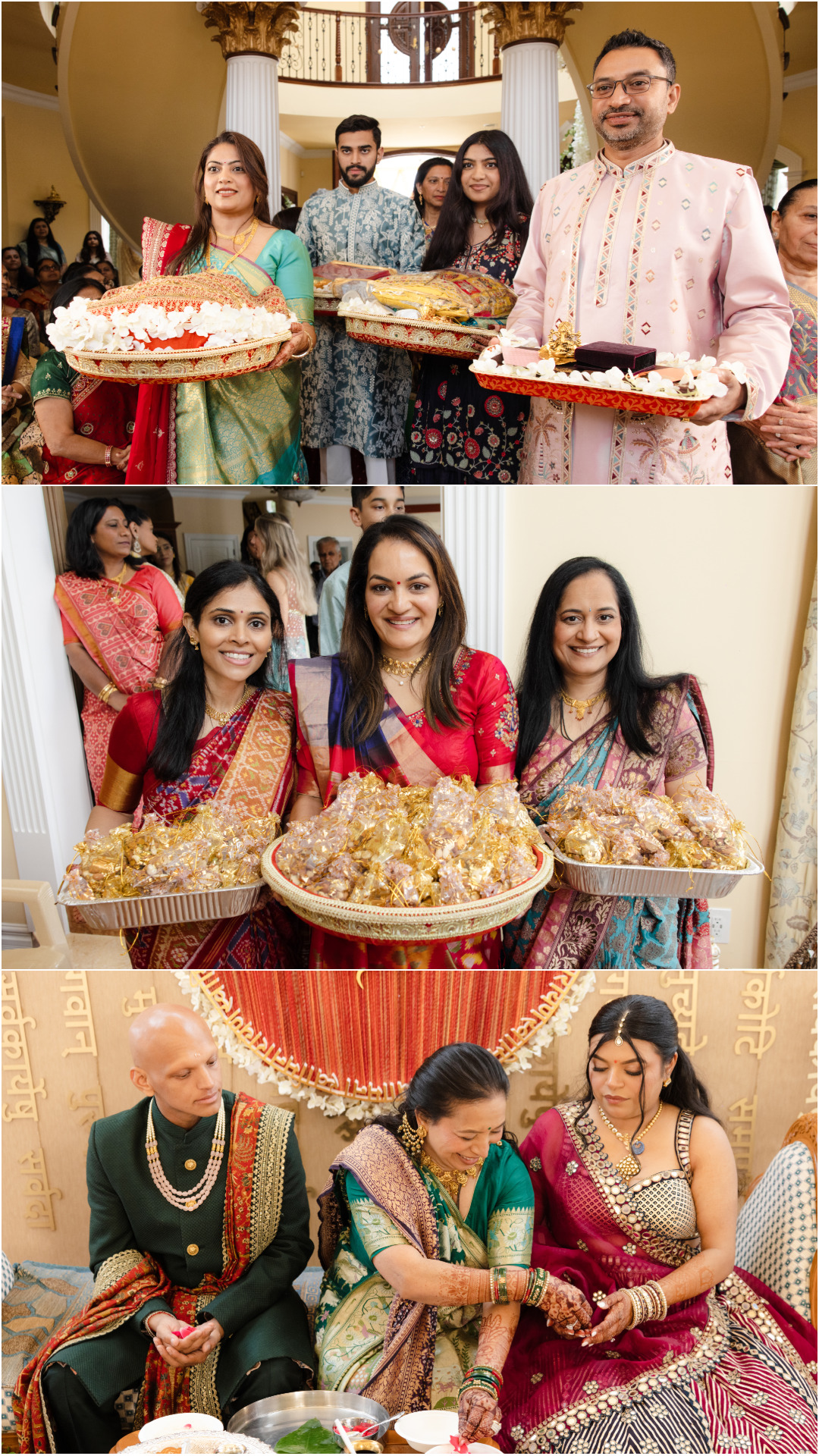
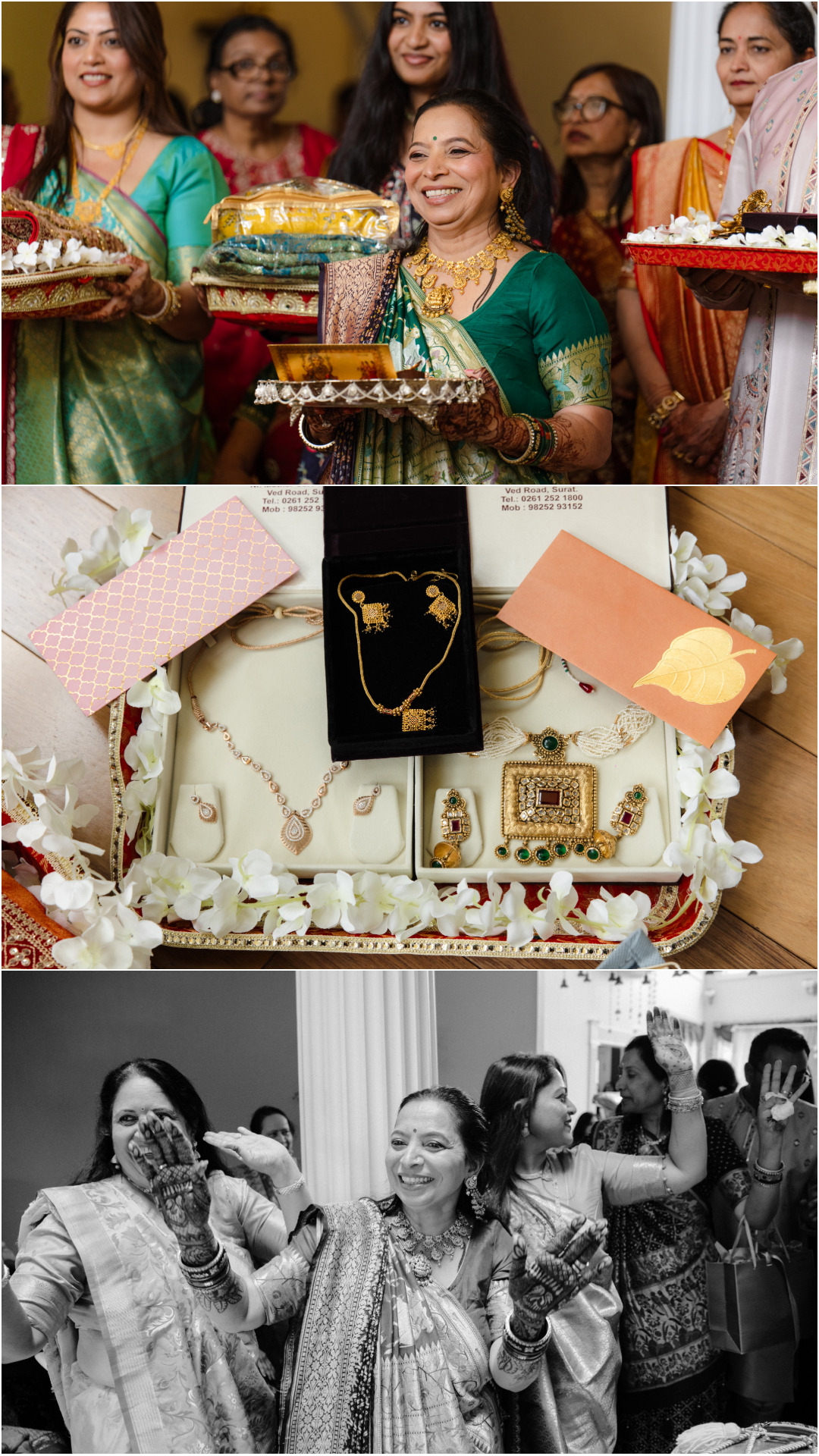
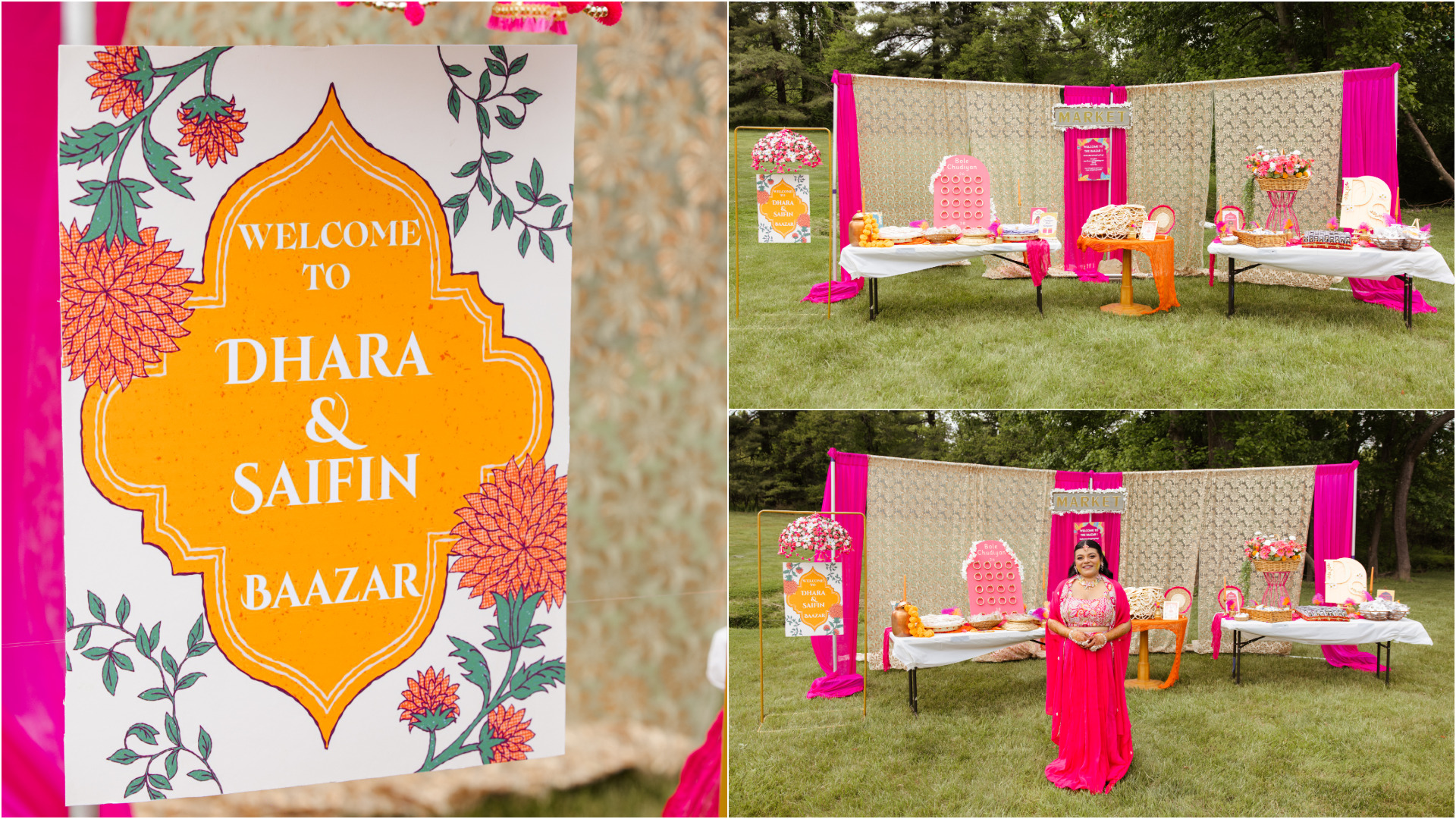
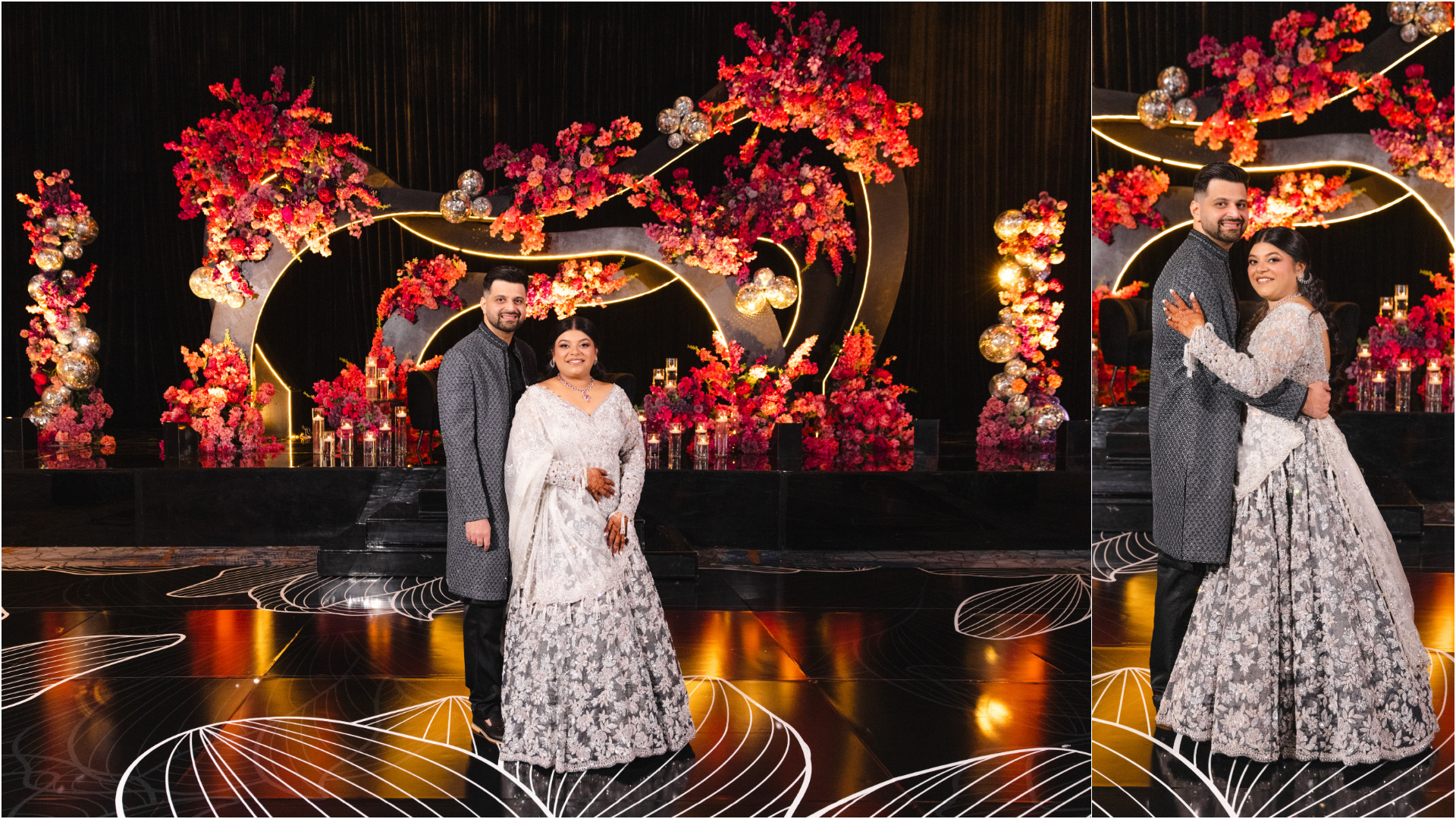
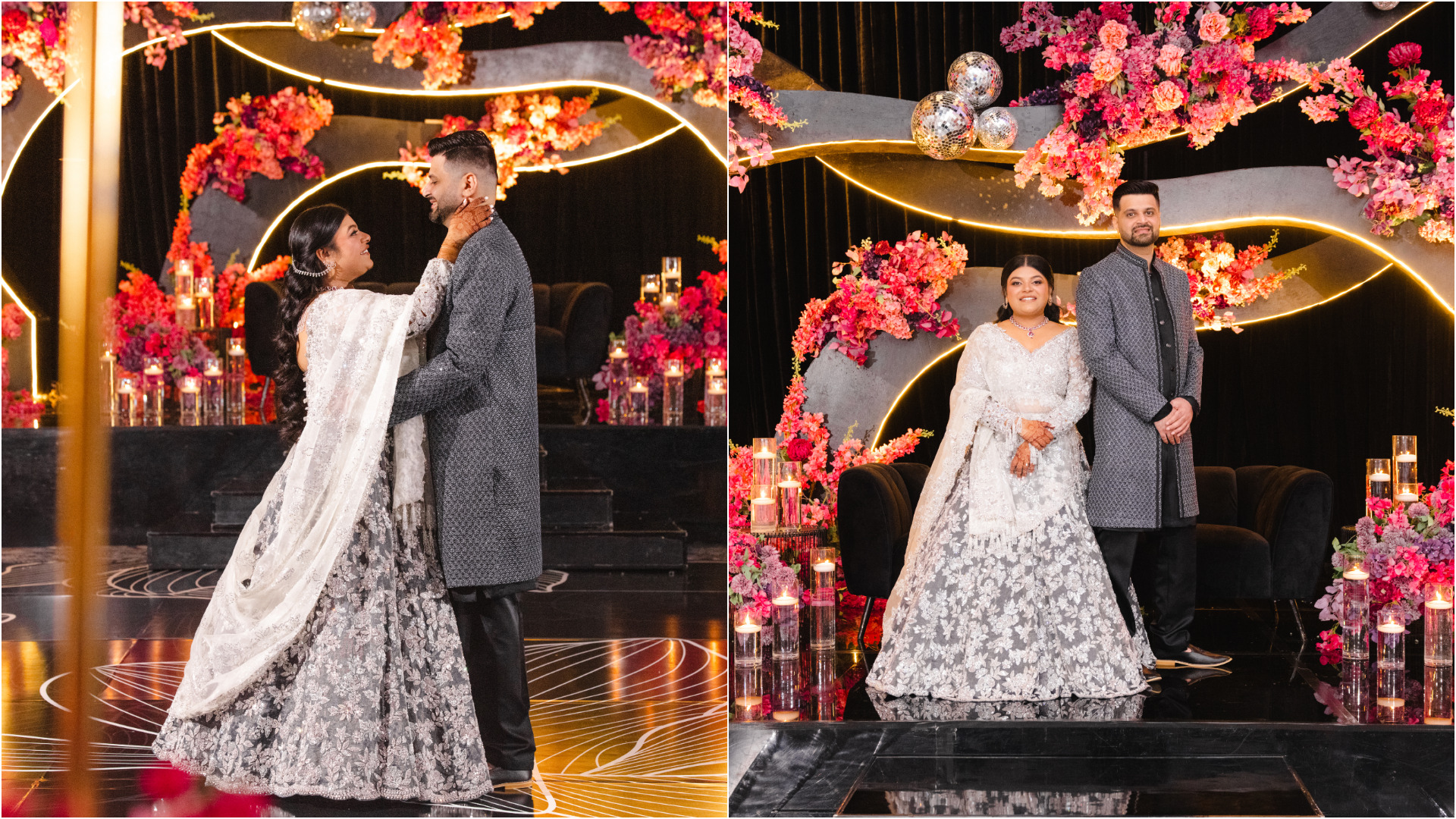
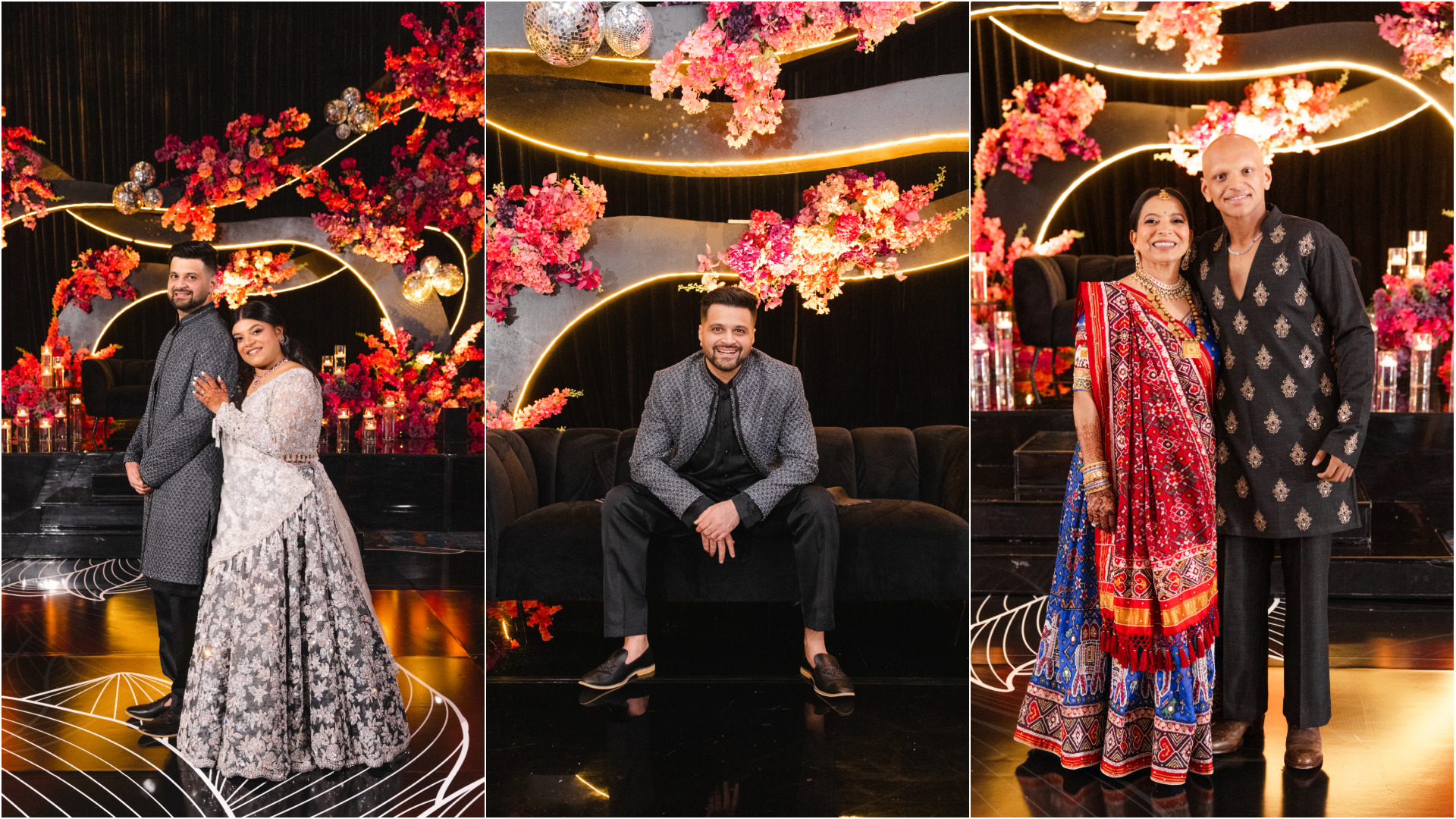
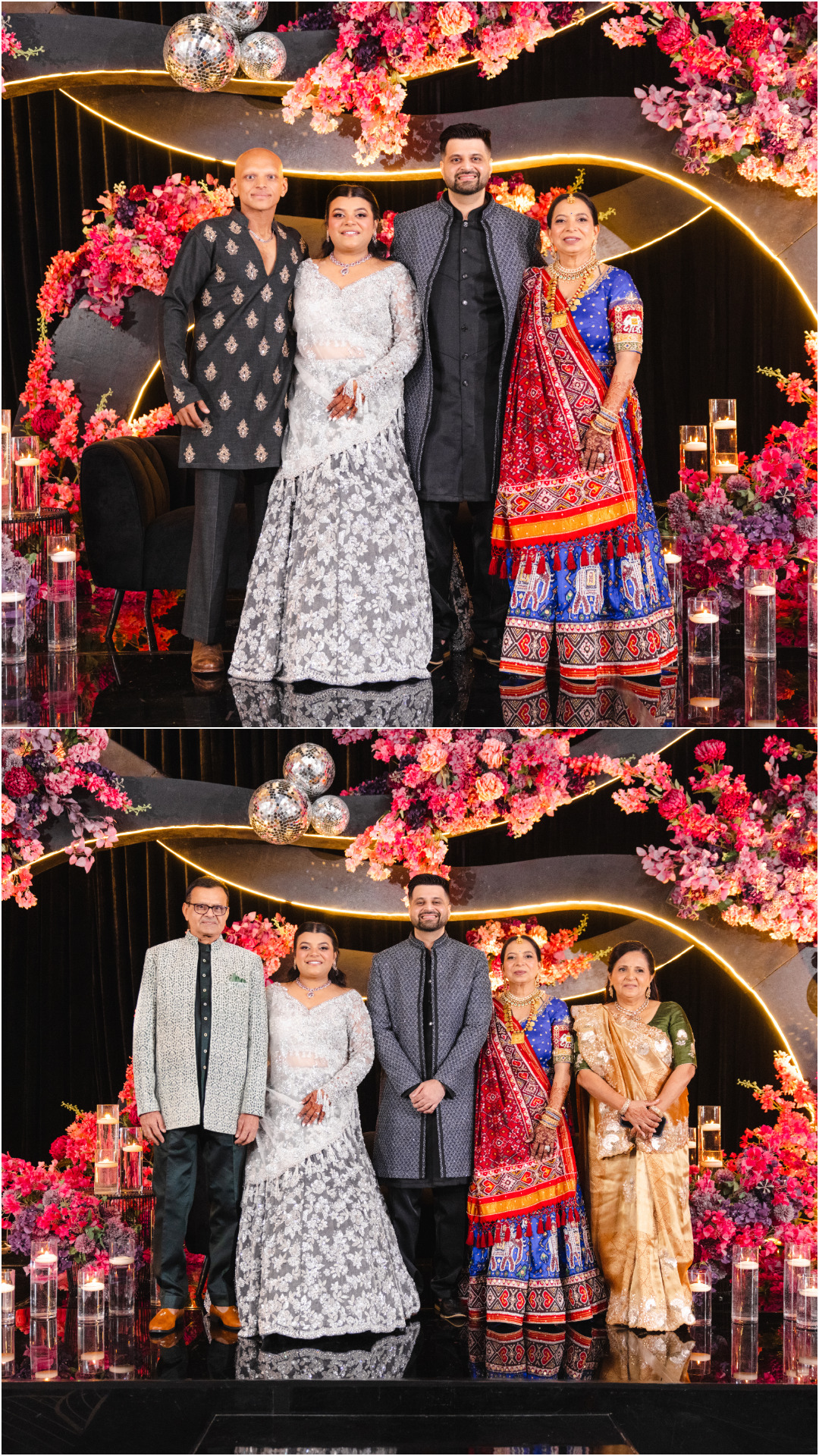
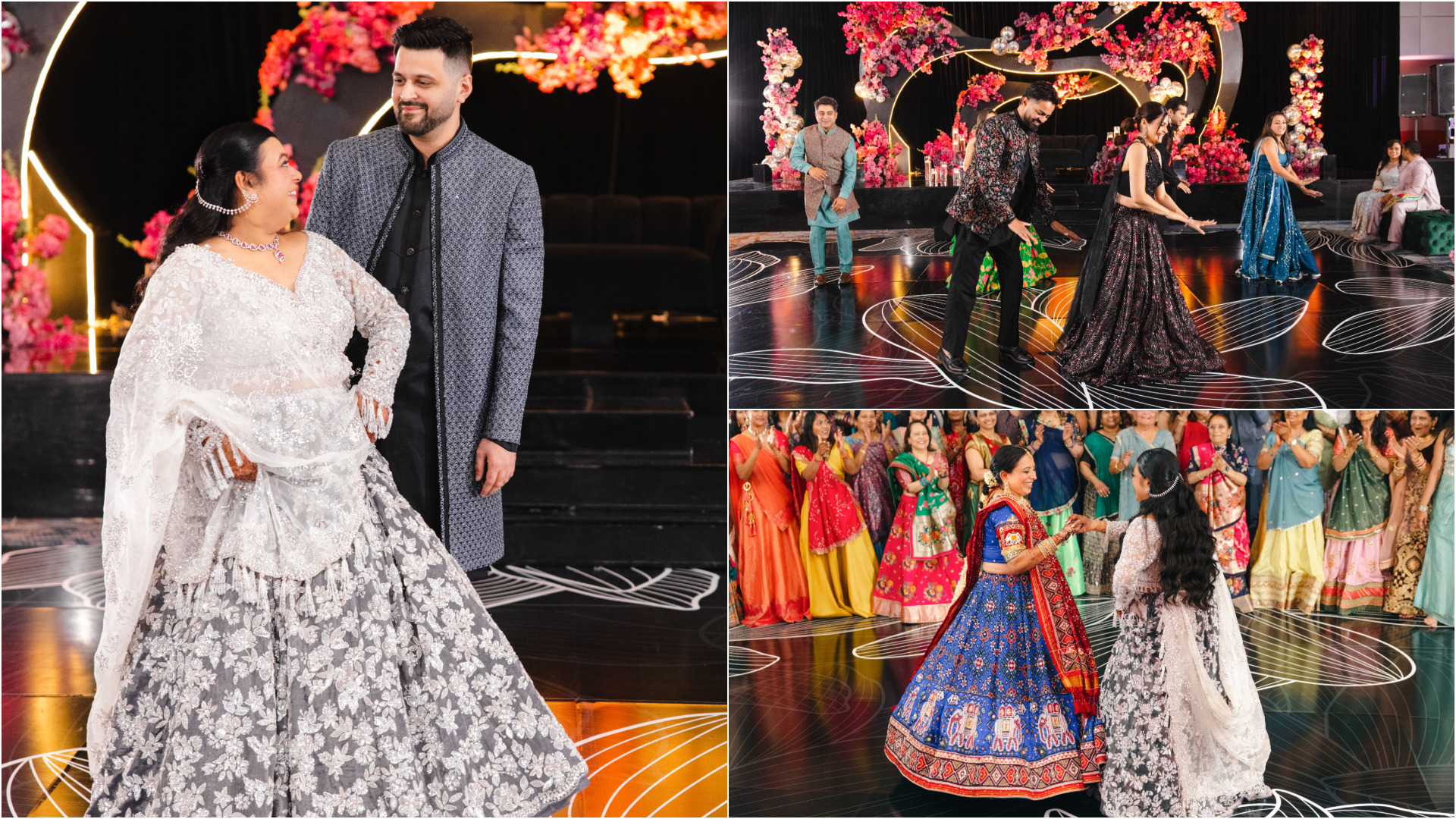
Dhara & Saifin’s Beautiful Indian Wedding at Hilton Baltimore Inner Harbor | Real Wedding by Shan Photography
Some weddings feel like events. Others feel like homecomings — where two families, two histories, and hundreds of people who love the same two humans collide in the best possible way for an entire weekend. Dhara and Saifin’s wedding at the Hilton Baltimore Inner Harbor was the second kind.
As a team that has photographed Indian weddings across the country — from Chicago ballrooms to destination celebrations in Mexico — we can tell you honestly: this Baltimore wedding weekend had a heartbeat of its own. Over three days, we watched henna dry under string lights, turmeric fly through laughter, a Baraat take over a downtown Baltimore street, and a ballroom at 401 W Pratt Street transform into something out of a dream.
This real wedding blog is part love story, part venue guide, and part photography education. If you’re a couple planning an Indian wedding in Baltimore, Maryland, Washington DC, Virginia, Pennsylvania, or New Jersey — or you’re simply searching for real wedding inspiration at the Hilton Baltimore Inner Harbor — settle in. We’re going to walk you through every event, every ritual, and every photography decision we made along the way, so you can plan (and picture) your own celebration with confidence.
Meet Dhara & Saifin
Dhara is the kind of bride photographers quietly hope for — expressive, warm, and completely unafraid to laugh with her whole face. She grew up surrounded by a big, loud, loving Gujarati family, the kind where aunties arrive three hours early to help and stay three hours late to dance.
Saifin is her perfect counterweight: calm, observant, and endlessly patient — until the dhol starts playing, at which point all composure is officially off the table. Together, they’re the couple who makes everyone else in the room feel like the most important guest.
What we loved most about photographing them is that they never performed for the camera. They simply lived their wedding, and trusted us to catch it. That trust is the foundation of every authentic wedding photograph you’ll see from this weekend.
Their Love Story
Dhara and Saifin met the way so many modern couples do — through mutual friends who insisted, repeatedly, that they’d be perfect together. The friends were right, though it took a group dinner, a long conversation that outlasted everyone else at the table, and a follow-up coffee “just to continue the conversation” for the two of them to admit it.
What began as easy conversation grew into a partnership built on the things that actually hold a marriage together: shared values, deep respect for each other’s families, and the ability to make each other laugh on the worst days, not just the best ones. When Saifin proposed, there was no question about what came next — a celebration big enough to hold both of their worlds.
Their wedding was also, beautifully, a blending of traditions. The couple honored Dhara’s Hindu heritage with a full mandap ceremony — Varmala, Kanyadaan, Saat Phere, Sindoor, and Mangalsutra — while weaving both families into every event of the weekend. If you’re planning a fusion or interfaith South Asian wedding, their weekend is proof that honoring tradition and celebrating togetherness are not competing goals. They’re the same goal.
The Wedding Planning Journey
Planning a multi-day Indian wedding is a logistics marathon: multiple events, multiple outfit changes, vendors for decor, catering, mehndi artists, DJs, dhol players, and a guest list that spans continents. Dhara and Saifin approached it the smart way — they chose a single venue that could hold the entire weekend.
That decision shaped everything. Keeping the Mehndi, Haldi, wedding ceremony, and reception under one roof at the Hilton Baltimore Inner Harbor meant no guest shuttles between venues, no lost hours in transit, and — from a photography perspective — more time for portraits and candid moments instead of travel. If there’s one planning tip we give every couple hosting an Indian wedding in Maryland, it’s this: minutes you don’t spend driving are minutes you get to spend celebrating (and being photographed).
The couple also did something we wish every couple did: they brought us into the timeline conversation early. We mapped out golden hour, ceremony light, and family photo windows months in advance. You’ll see the payoff in every image.
About Hilton Baltimore Inner Harbor
The Hilton Baltimore Inner Harbor sits at 401 W Pratt St, Baltimore, MD 21201, directly across from Oriole Park at Camden Yards and just a short walk from Baltimore’s famous Inner Harbor waterfront. It’s one of the largest hotels in Maryland, which matters enormously for Indian weddings — you need real square footage for a 300+ guest celebration with a mandap, a dance floor, and a Baraat.
Why This Venue Was Perfect
Couples often ask us: is the Hilton Baltimore Inner Harbor a good wedding venue? After photographing Dhara and Saifin’s weekend there, our answer is an enthusiastic yes — especially for South Asian weddings. Here’s why:
- Multiple event spaces under one roof. The hotel’s ballrooms and event rooms allowed the Mehndi, Haldi, ceremony, and reception to each have a distinct look without anyone leaving the building.
- True ballroom scale. The Key Ballroom is one of the largest hotel ballrooms in the region — high ceilings, wide sightlines, and room for a grand mandap and a full dance floor.
- Guest convenience. With hundreds of guest rooms upstairs, out-of-town family (and there was a lot of out-of-town family) simply took the elevator home each night.
- Downtown Baltimore at the doorstep. Camden Yards, the Inner Harbor promenade, Federal Hill, and the downtown skyline are all within minutes — a portrait photographer’s playground.
- A team experienced with cultural weddings. Vendors could load in mandap structures, stage the Baraat outside, and accommodate the rhythm of a multi-day Indian celebration.
Venue Highlights & Photography Opportunities Around the Hotel
Where are the best portrait locations at the Hilton Baltimore Inner Harbor? This is one of the most common questions we get from couples booking this venue, so here’s our honest, boots-on-the-ground answer:
- The upper-floor windows facing Camden Yards — soft, directional window light with the ballpark and skyline behind you. Dhara’s getting-ready portraits here are some of our favorites of the entire year.
- The modern glass architecture at the Pratt Street entrance — clean lines and reflections that make bridal portraits feel editorial.
- The skywalk and lobby staircases — dramatic leading lines for couple portraits between events.
- The Inner Harbor promenade, five minutes away — waterfront golden hour portraits with sailboats and the Baltimore skyline.
- Federal Hill Park, a short drive across the harbor — the classic elevated view of downtown Baltimore, unbeatable for sunset couple portraits.
If you’re searching for where to take wedding portraits in Baltimore, this cluster of locations — all within minutes of the hotel — is exactly why photographers love working downtown.
The Wedding Weekend Timeline
For couples planning a similar celebration, here’s how Dhara and Saifin’s three-day Hilton Baltimore Inner Harbor wedding weekend flowed:
- Friday evening — Mehndi: Henna, music, dancing, and family arrivals
- Saturday morning — Haldi: Turmeric ceremony for both bride and groom
- Sunday morning — Baraat & Hindu Wedding Ceremony: Mandap ceremony in the ballroom
- Sunday evening — Reception: Grand entrance, first dance, speeches, and a packed dance floor until the very last song
Now, let’s walk through each event the way we experienced it — through the lens.
Event 1 — The Mehndi: Where the Wedding Weekend Begins
What Is a Mehndi Ceremony?
For readers new to Indian wedding traditions: the Mehndi is the celebration where intricate henna designs are applied to the bride’s hands and feet, traditionally symbolizing beauty, joy, and the deepening bond of marriage. There’s a beloved saying that the darker the bride’s mehndi stains, the deeper her partner’s love — and yes, the aunties will absolutely inspect the color the next morning. It’s also, practically speaking, the first big gathering of the wedding weekend, which means it doubles as a reunion, a dance party, and an emotional warm-up for everything to come.
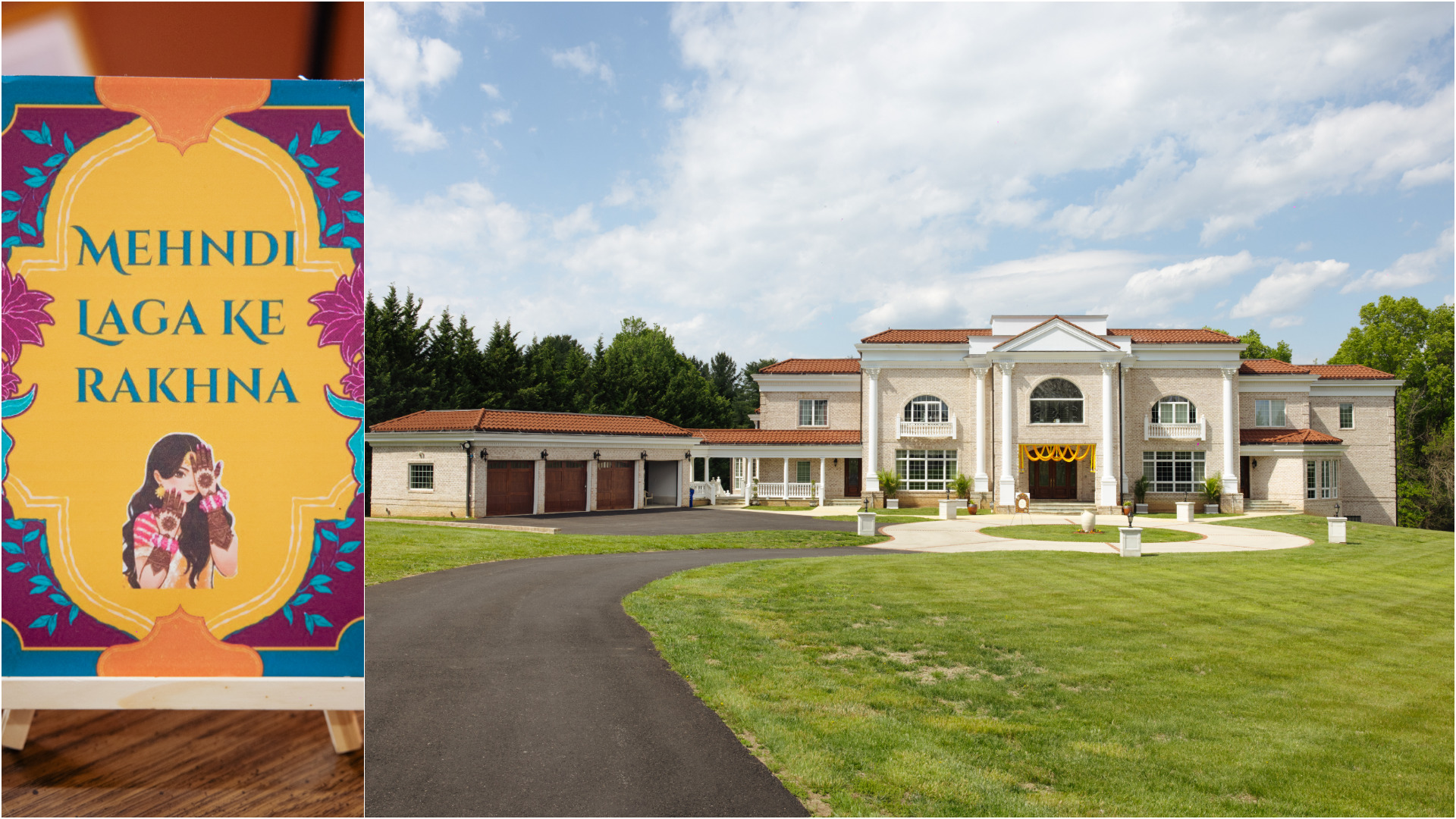
Dhara and Saifin’s Mehndi Ceremony in Baltimore was held Friday evening in one of the Hilton’s event rooms, transformed for the night into something that felt lifted straight from a Rajasthani courtyard.
The Decor: Marigolds, Lanterns, and Color Everywhere
The decor team leaned into everything a Mehndi should be — saturated, joyful, and a little bit magical. Strings of marigolds in orange and yellow draped the walls. Low seating with jewel-toned cushions surrounded the bride’s mehndi station. Colorful lanterns and hanging umbrellas floated overhead, and a floral swing seat gave Dhara a throne worthy of the evening.
From a photography standpoint, Mehndi decor like this is a gift. Color is emotion, and every candid photo taken against that backdrop instantly reads as festive. If you’re planning your own Mehndi, invest in a beautiful, well-lit seat for the bride — she’ll be stationary for two to three hours while her henna is applied, and that seat becomes the visual anchor of half the evening’s photos.
Dhara’s Mehndi
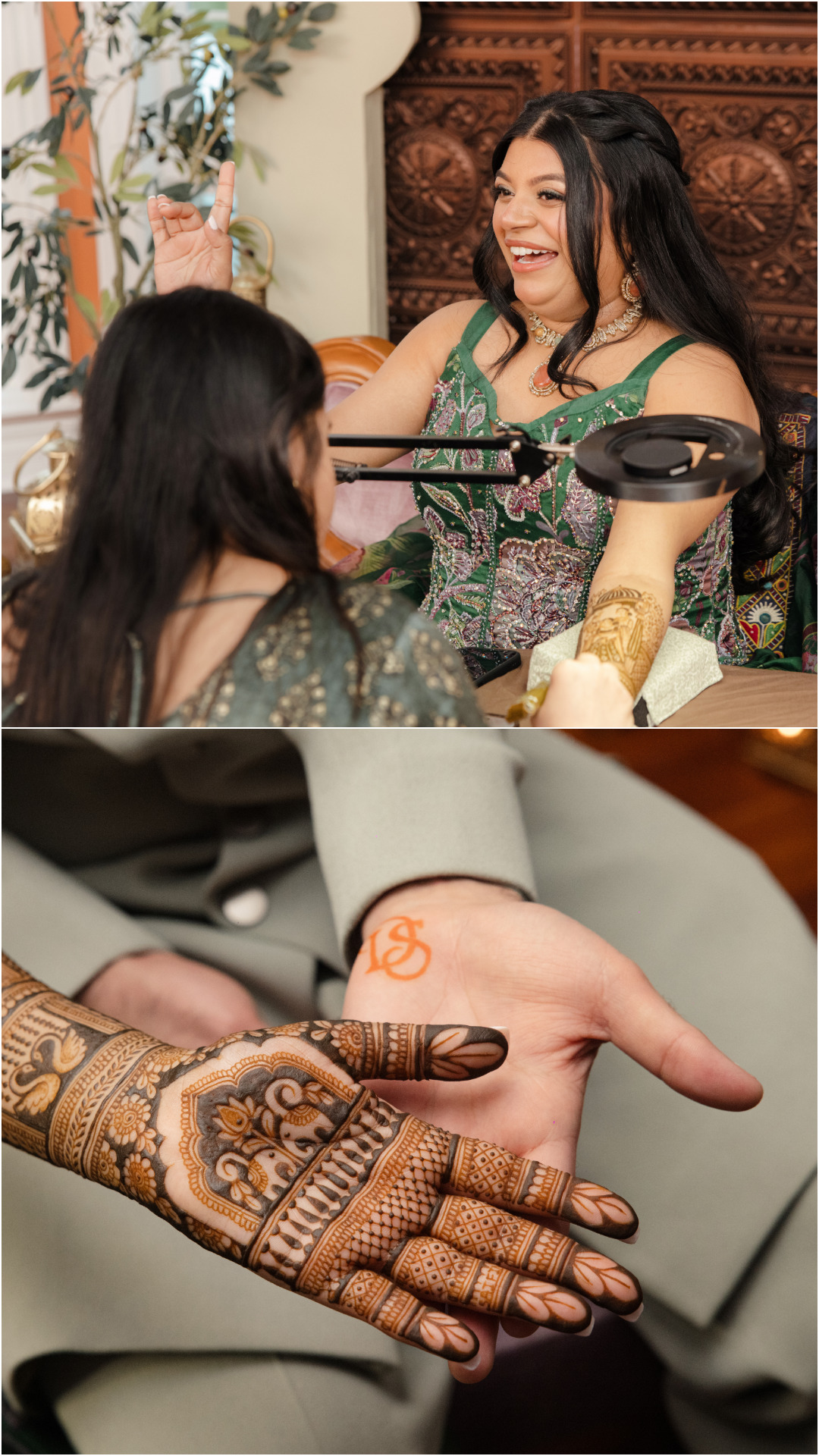
Dhara wore a vibrant, mirror-work lehenga in sunset shades of orange and pink, with floral jewelry that photographed beautifully against her henna. Her mehndi artist worked for hours, weaving traditional bridal motifs — peacocks, paisleys, floral vines — up her forearms, with Saifin’s name hidden somewhere in the design (finding it later became a game of its own).
Close-up mehndi photography is genuinely one of our favorite disciplines in Indian wedding photography. We shoot with macro-capable lenses and position the bride near clean, soft light so every line of wet henna glistens. The details matter here: the cone in the artist’s hand, the half-finished pattern, Dhara’s rings set aside on a velvet cushion. These are the images that make a wedding album feel like a documentary rather than a highlight reel.
Family, Friends, Music, and Mayhem (the Good Kind)
While Dhara’s henna dried, the party did not wait. Guests took turns getting their own mehndi. A dhol player pulled people out of their chairs. There were choreographed dances from cousins on both sides, an impromptu sangeet-style singing battle between the two families, and games that had grandparents laughing as hard as the college friends.
Saifin, for the record, was in the middle of all of it — the groom’s job at a Mehndi is to be joyful and slightly outnumbered, and he embraced both.
These are the hours where second-photographer coverage earns its keep. One of us stayed close to Dhara for the intimate, quiet frames — her mother leaning in to whisper something, her best friend fanning the henna dry. The other roamed the dance floor catching the chaos. You cannot photograph a Mehndi properly from one position; the event happens everywhere at once.
Photography Challenges & Tips for Mehndi Ceremonies
Honest professional talk for couples and fellow photographers:
- Mehndi lighting is usually dim and warm. String lights and lanterns are gorgeous but low-output. We shoot with fast prime lenses and add subtle off-camera flash bounced away from the henna station so we never flatten the ambiance.
- The bride can’t move her hands. Plan bridal portraits before henna application, or embrace it — some of our favorite frames are Dhara laughing while a cousin holds a snack up to her mouth because her hands were off-limits.
- Schedule the henna early. Bridal mehndi takes 2–4 hours. Starting early means the bride actually gets to dance at her own party — and we get those images too.
- Detail shots first. We photograph the decor, the mehndi cones, the floral jewelry, and the outfit details before guests arrive, while everything is pristine.
By the end of the night, Dhara’s mehndi was deep and intricate, the dance floor was still going, and the weekend had officially begun.
Event 2 — The Haldi: Turmeric, Laughter, and Golden Light
What Is a Haldi Ceremony?
The Haldi is one of the most photogenic rituals in any Indian wedding — and one of the most meaningful. A paste of turmeric, sandalwood, and rose water is applied to the bride and groom by their loved ones. Traditionally, haldi is believed to bless the couple, ward off negativity, and give their skin a natural glow before the wedding day. In practice, it’s also thirty minutes of pure, unfiltered joy where decorum goes out the window and everyone ends up at least a little bit yellow.
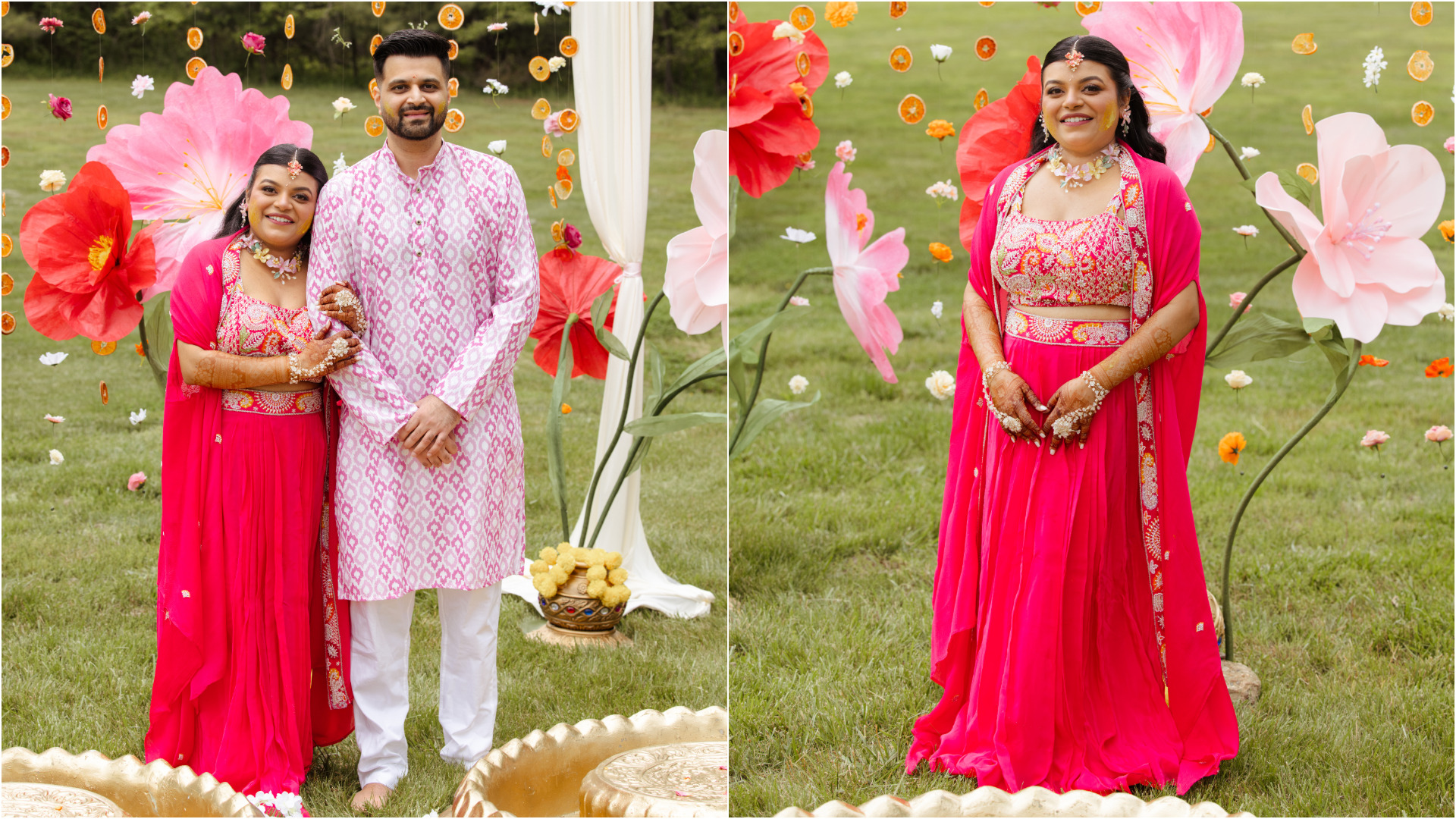
Dhara and Saifin held their Haldi Ceremony in Baltimore on Saturday morning at the Hilton, in a bright event space the decor team had drenched in yellow.
A Room Dressed in Sunshine
Yellow marigolds. Yellow drapes. Yellow florals framing a low white seating area where the couple would sit. Guests were asked to wear yellow and shades of gold, and the effect — when we stood at the back of the room and looked across a sea of saffron and marigold outfits — was like photographing inside a sunrise.
For couples planning their own Haldi: this monochrome approach is one of the best decor decisions you can make for photography. When the whole room shares a palette, every candid image looks intentional, and the turmeric itself blends into the story instead of clashing with it.
The Ritual — and the Beautiful Chaos That Follows
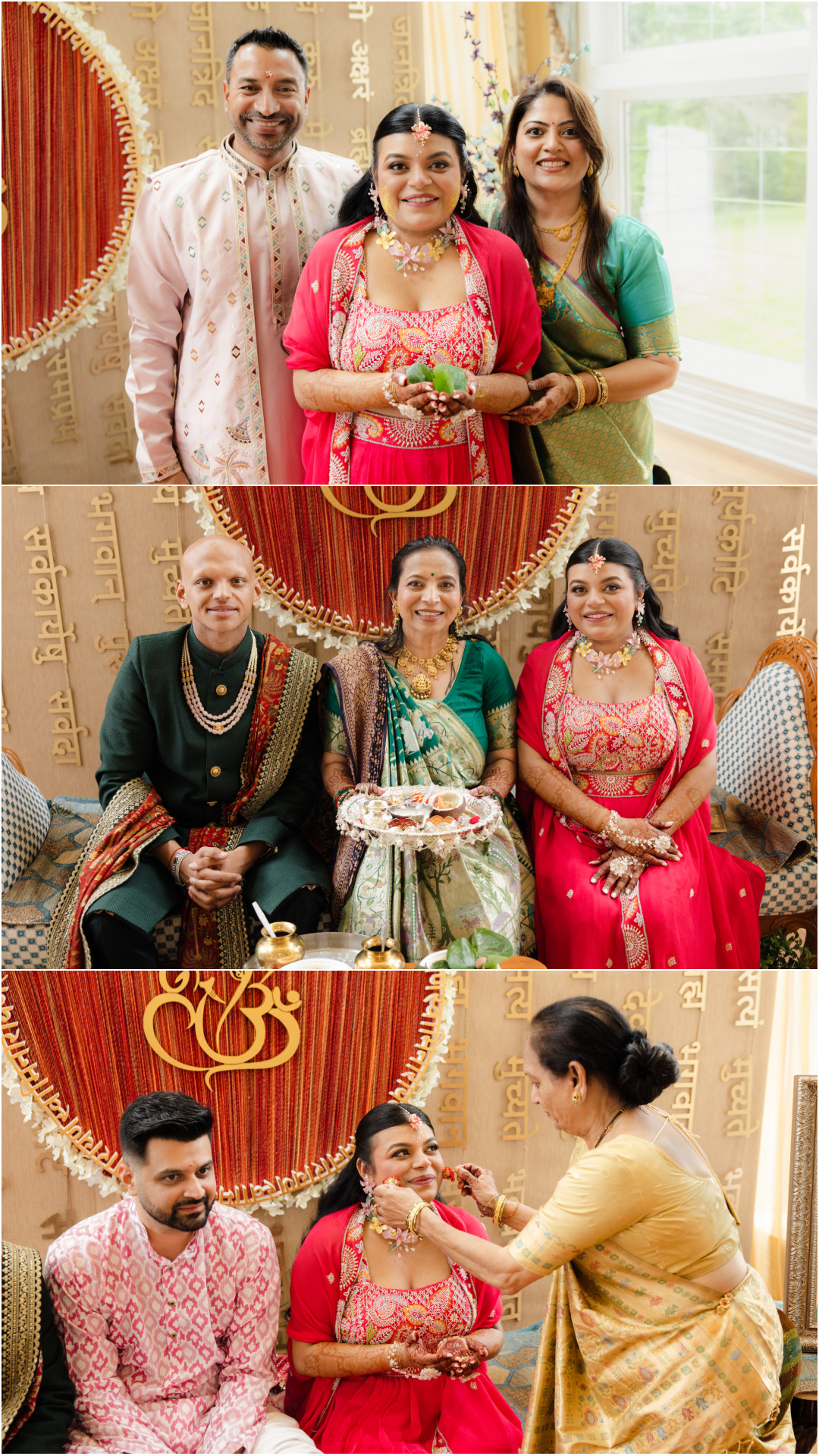
The ceremony began tenderly. Dhara’s mother applied the first touch of haldi to her daughter’s cheeks with tears already forming. Grandparents blessed her. One by one, family members took their turn — a smear on the arms, a dab on the face, a whispered blessing.
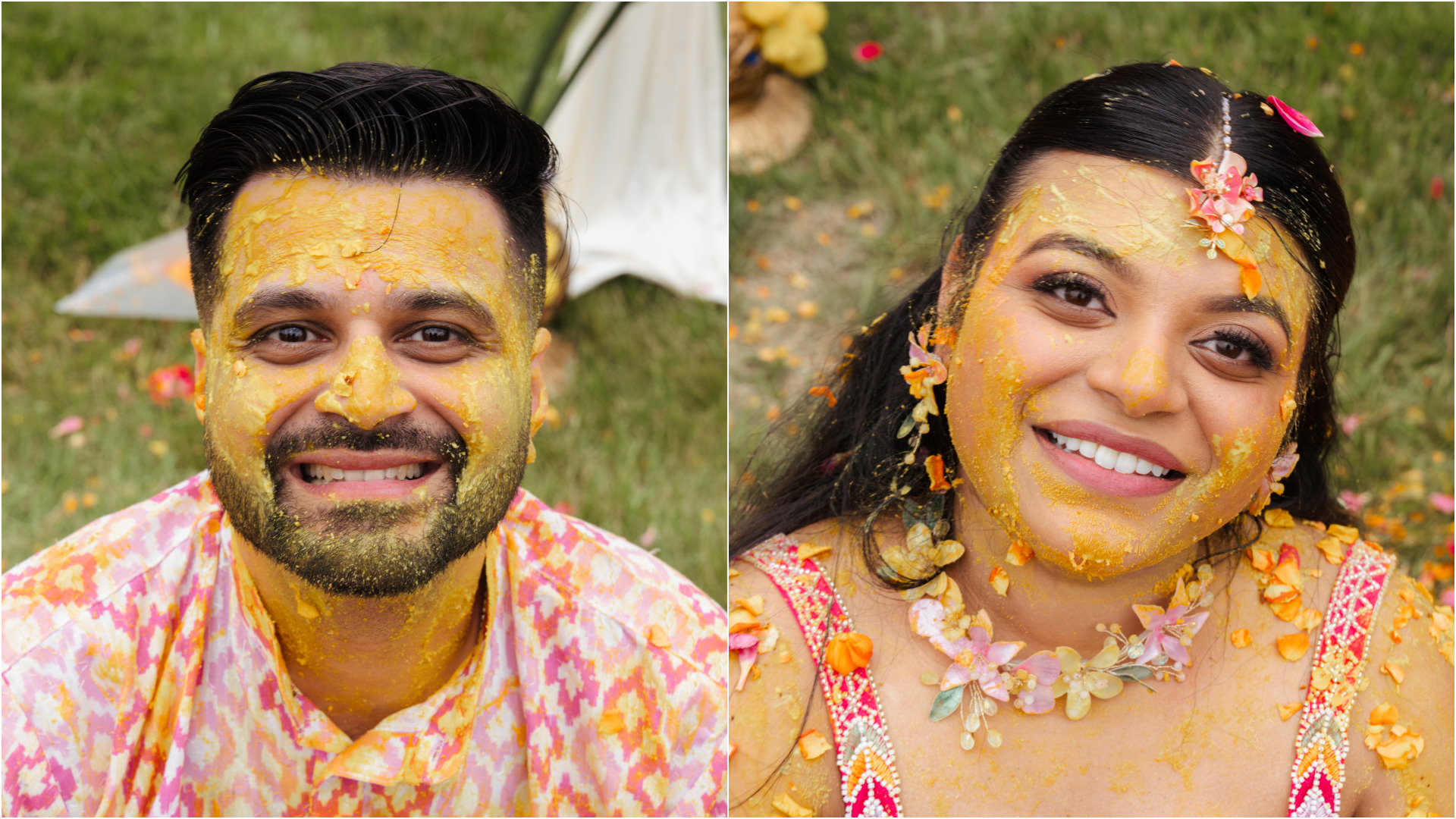
And then, as it always does, the tenderness gave way to mischief. Cousins arrived with handfuls, not dabs. Saifin’s friends treated the ritual less like a blessing and more like a competitive sport. By the end, both bride and groom were gloriously golden, laughing too hard to protest, with turmeric in places turmeric was never meant to go.
This emotional arc — reverence into riot — is exactly what we’re trained to capture at an Indian Haldi ceremony. The photographs people cry over later are rarely the posed ones. They’re the mother’s hands. The grandfather’s blessing. The exact frame where the first fistful of haldi lands and the whole room erupts.
Haldi Photography Tips from Shan Photography
- Chase the window light. We positioned the couple’s seating near the room’s natural light so the turmeric’s yellow tones stayed true and skin tones stayed warm and flattering. Harsh overhead lighting turns haldi photos green-ish; window light makes them glow.
- Protect your gear, not your position. Turmeric flies. We keep lens cloths in every pocket and shoot the chaos up close anyway — long-lens Haldi photos feel detached, and this is not a detached event.
- Shoot fast and wide, then tight. Wide frames capture the room-wide laughter; tight frames catch turmeric-streaked faces and joyful tears. Both belong in the album.
- Do the fun portraits immediately after. Yellow-smeared couple portraits, the sunglasses shot, the family group covered in haldi — take these before anyone washes up. Ten minutes later, the evidence is gone.
We ended the morning with our favorite kind of Haldi portrait: Dhara and Saifin, faces golden, foreheads touching, laughing at something no one else heard. If a single photo could summarize a wedding weekend’s spirit, for this couple, it’s that one.
Event 3 — The Wedding Ceremony: A Mandap in the Heart of Baltimore
Sunday morning. The big one. Everything about this day was intentional — and it started hours before any guest arrived.
Getting Ready: The Calm Before the Beautiful Storm
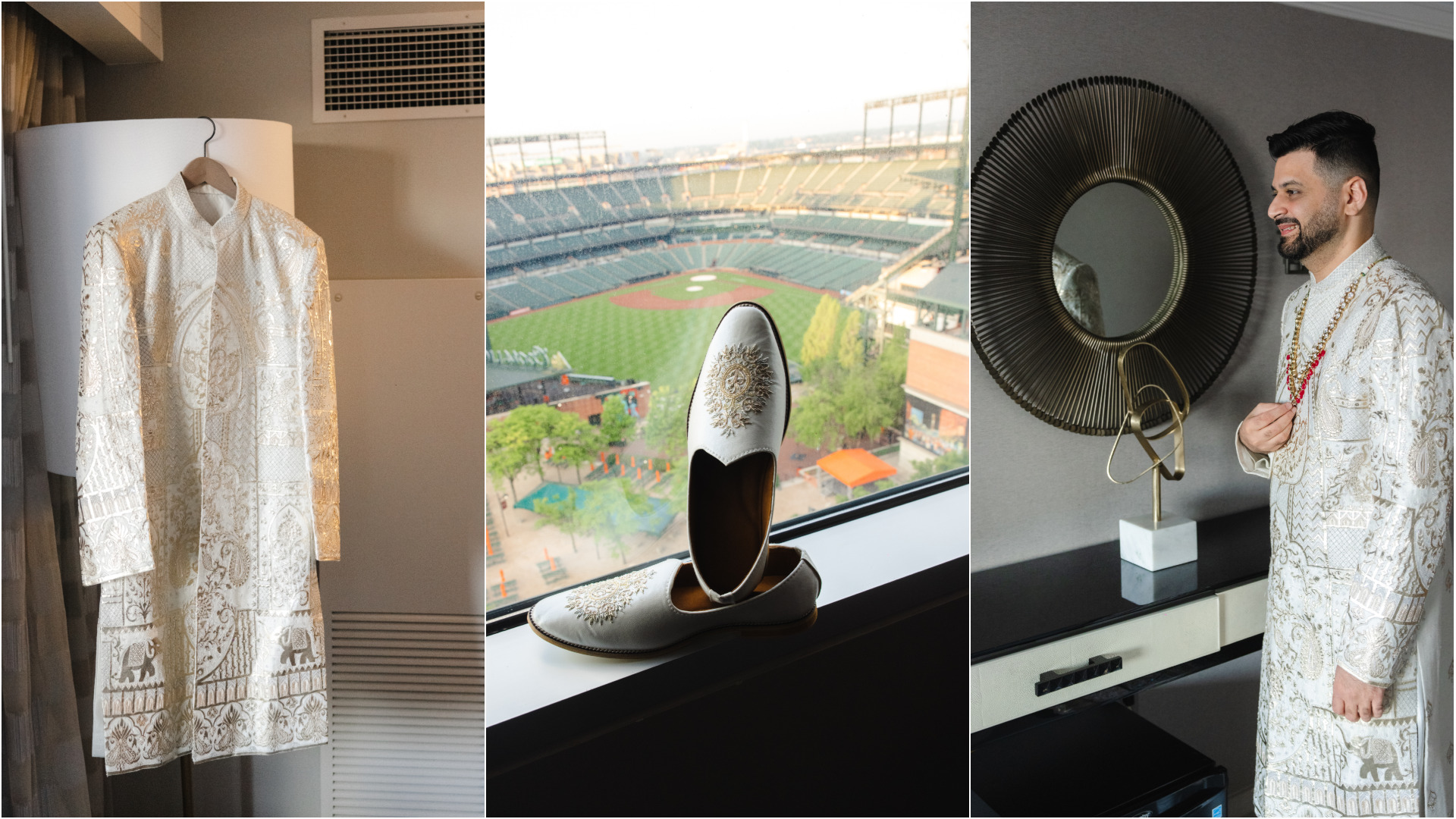
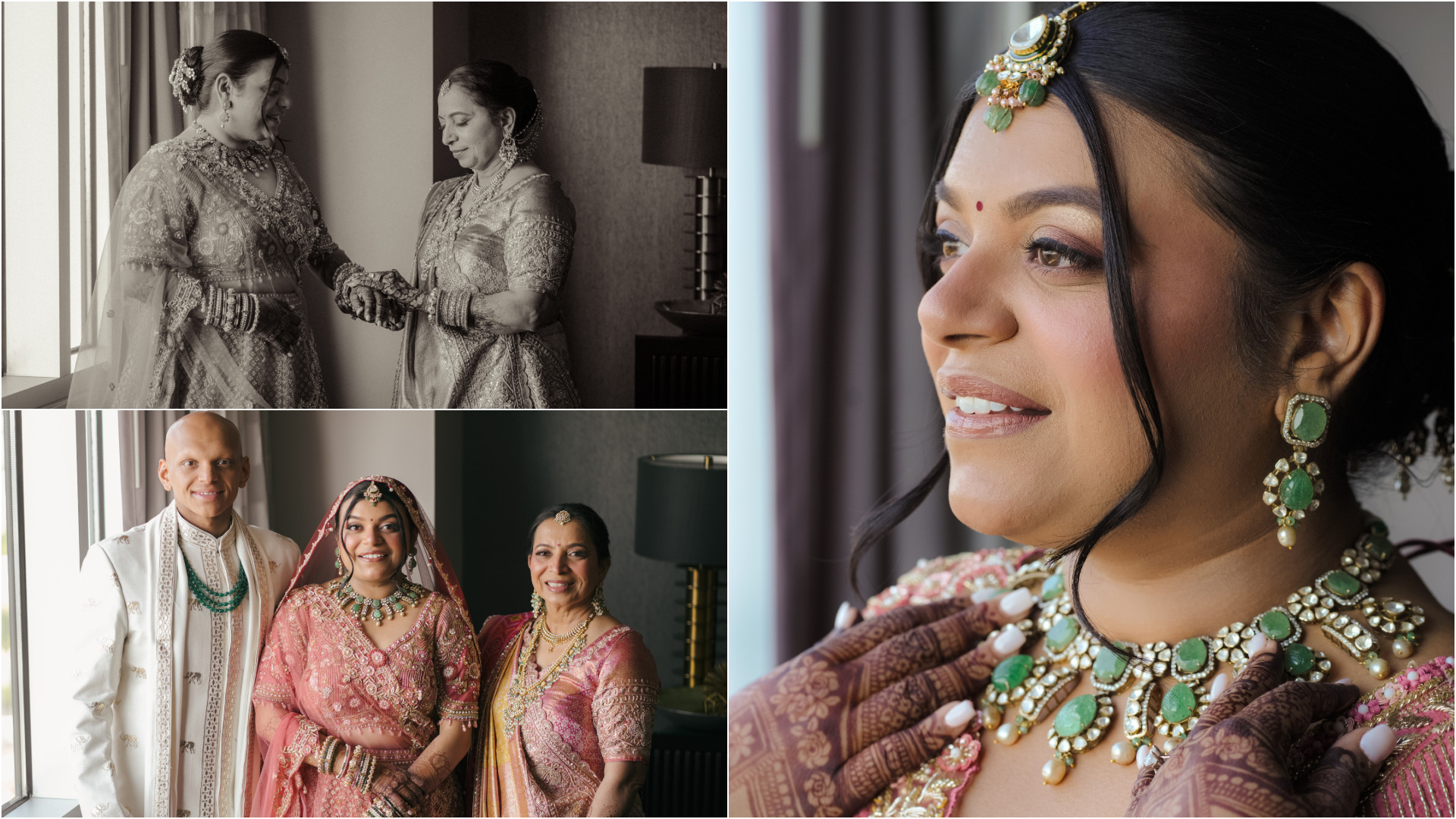
We split our team at sunrise. One photographer went to Dhara’s suite; the other to Saifin’s. Getting-ready coverage is where a wedding story actually begins, and the Hilton Baltimore Inner Harbor’s suites — with their tall windows overlooking Camden Yards and the downtown skyline — gave us exactly the light we needed.
In Dhara’s suite: quiet music, her mother steaming the dupatta, her bridesmaids in matching robes, and a makeup artist working with the window light. In Saifin’s: considerably more coffee, a rotating cast of groomsmen, and his father helping him with his final touches — a small moment that put a lump in our second shooter’s throat.
The Details: Jewelry, Invitation Suite, and Bridal Couture
Before the bride ever steps into her outfit, we photograph the artifacts of the day — because twenty years from now, these objects will carry memory like nothing else:
- The invitation suite, styled flat with florals borrowed from the decor team
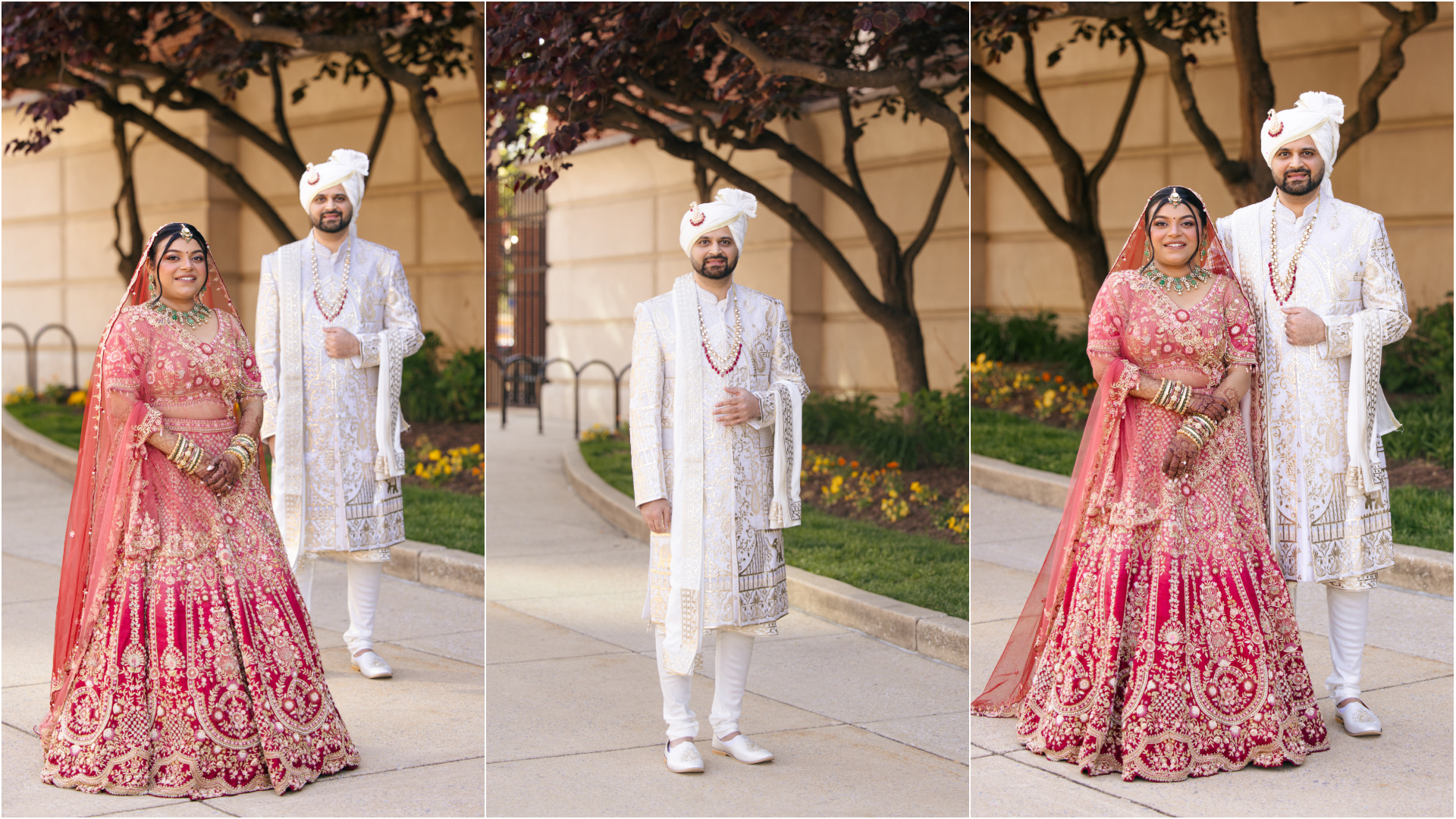
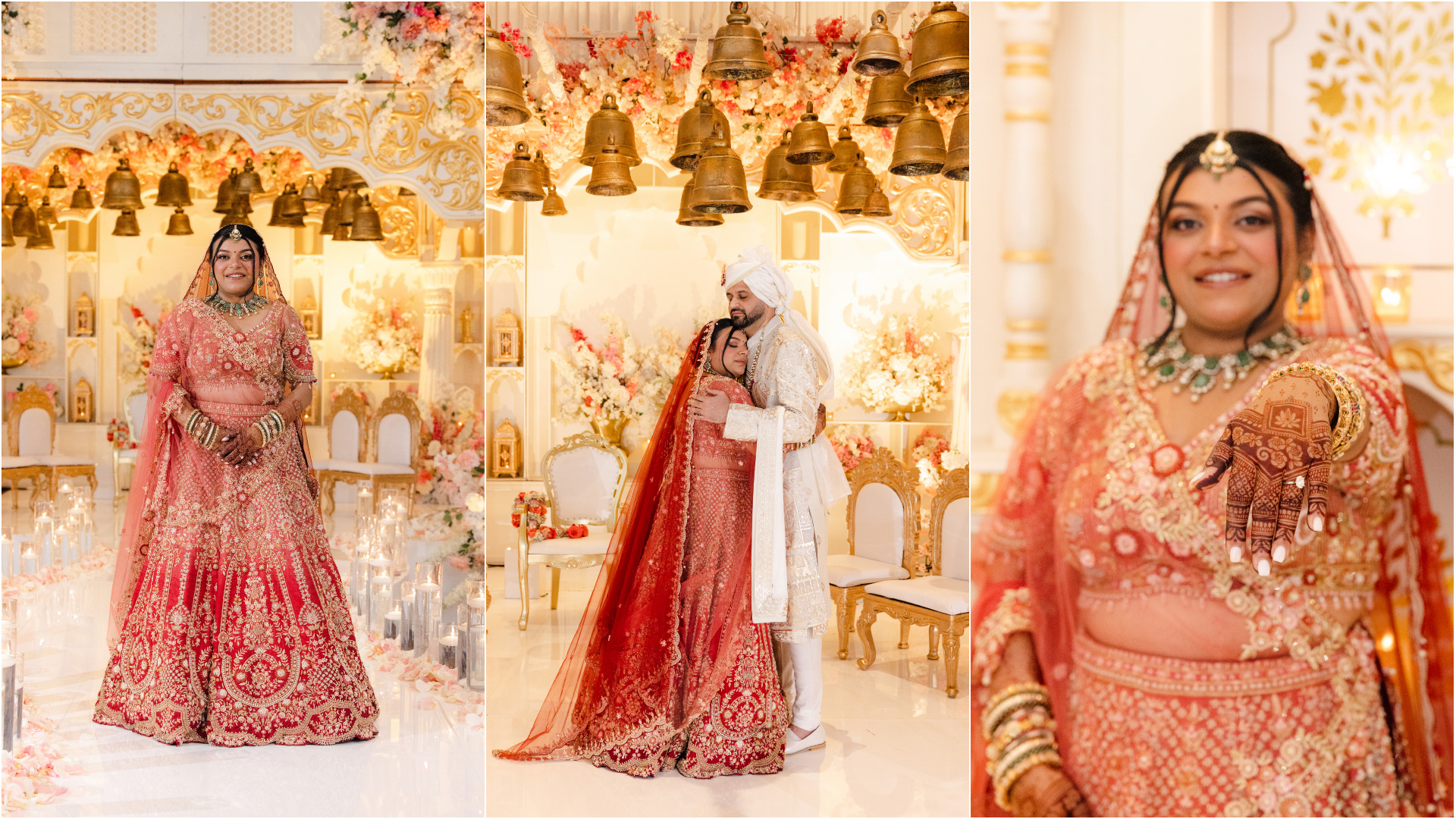
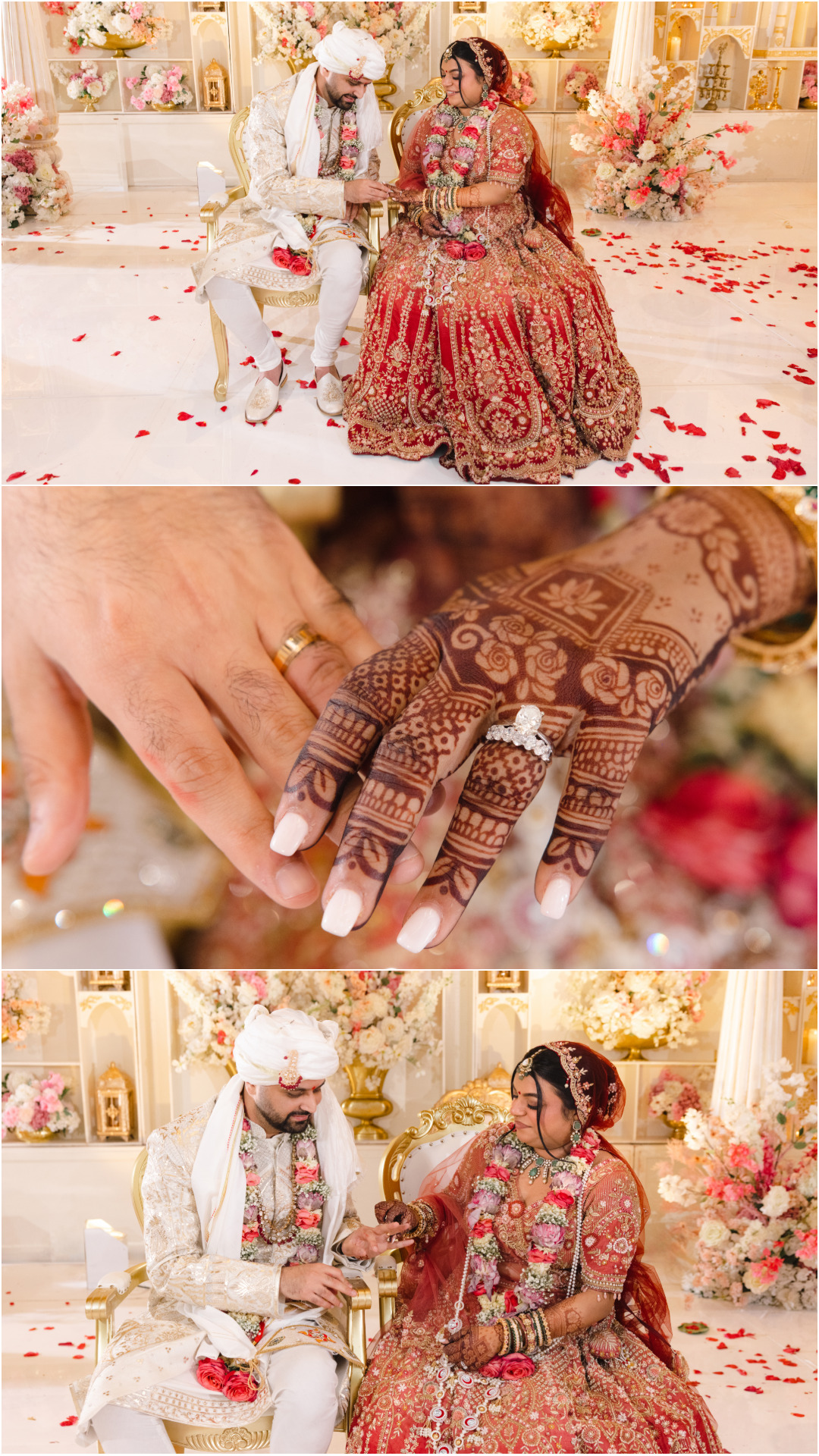
- Dhara’s bridal jewelry — a layered kundan and polki set with a statement maang tikka, jhumkas, chooda, and delicate hathphool draping over her fresh mehndi
- The bridal lehenga — deep red with antique gold embroidery, hours of hand-work visible in every close-up, hung against the suite’s window light
- Saifin’s sherwani — ivory and gold with a crimson stole that tied his look to Dhara’s, paired with a safa (turban), a kalgi brooch, and traditional mojari shoes
Photographing bridal details isn’t vanity — it’s preservation. Wedding outfits get packed away; jewelry gets locked in safes. The photographs are how these heirlooms stay part of daily life.
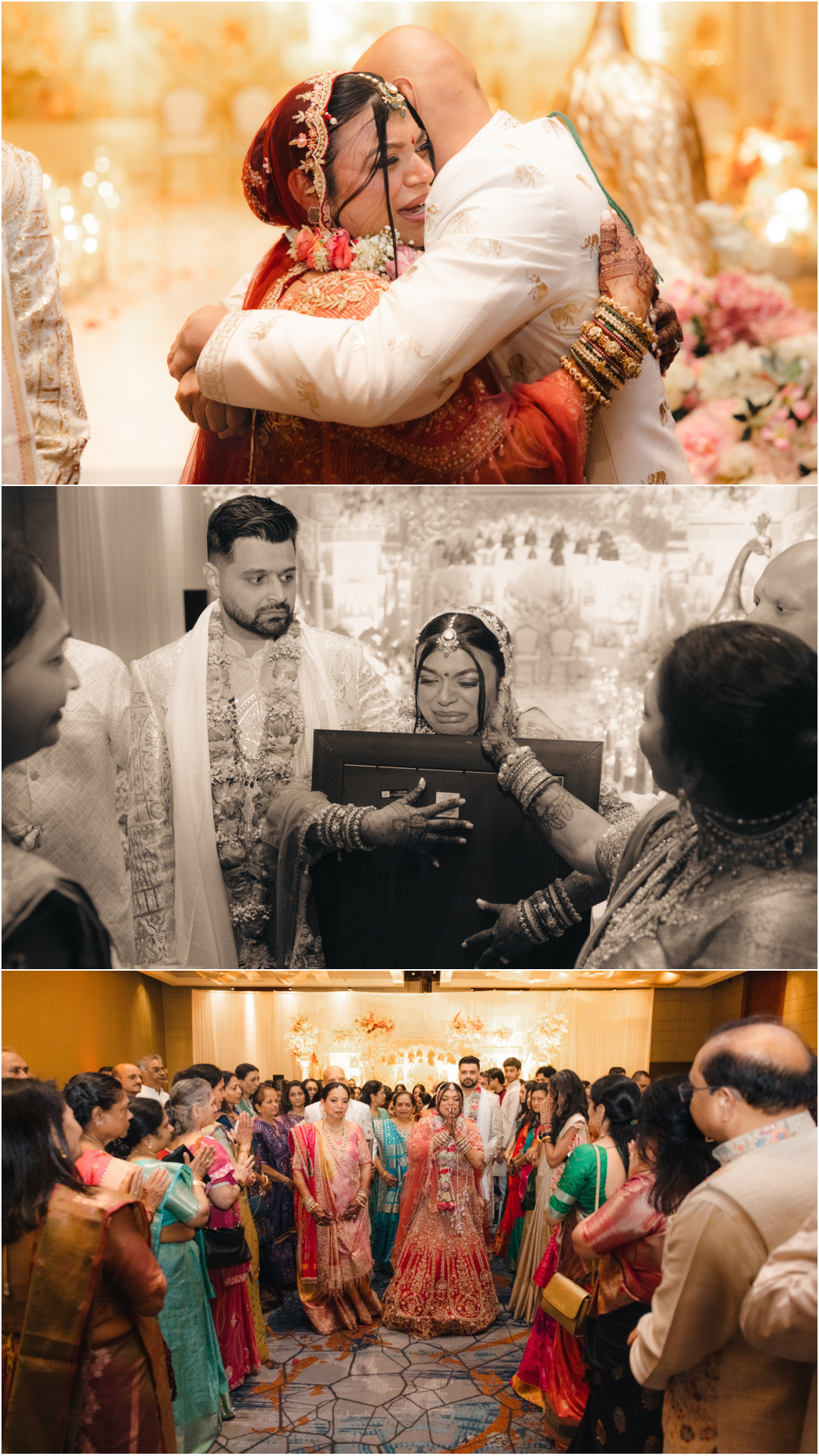
When Dhara was finally dressed — dupatta pinned, veil set, chooda stacked — her mother saw her and simply stopped speaking. We have that frame. It might be the most valuable photograph of the entire weekend.
The Baraat: A Dhol Takes Over Pratt Street
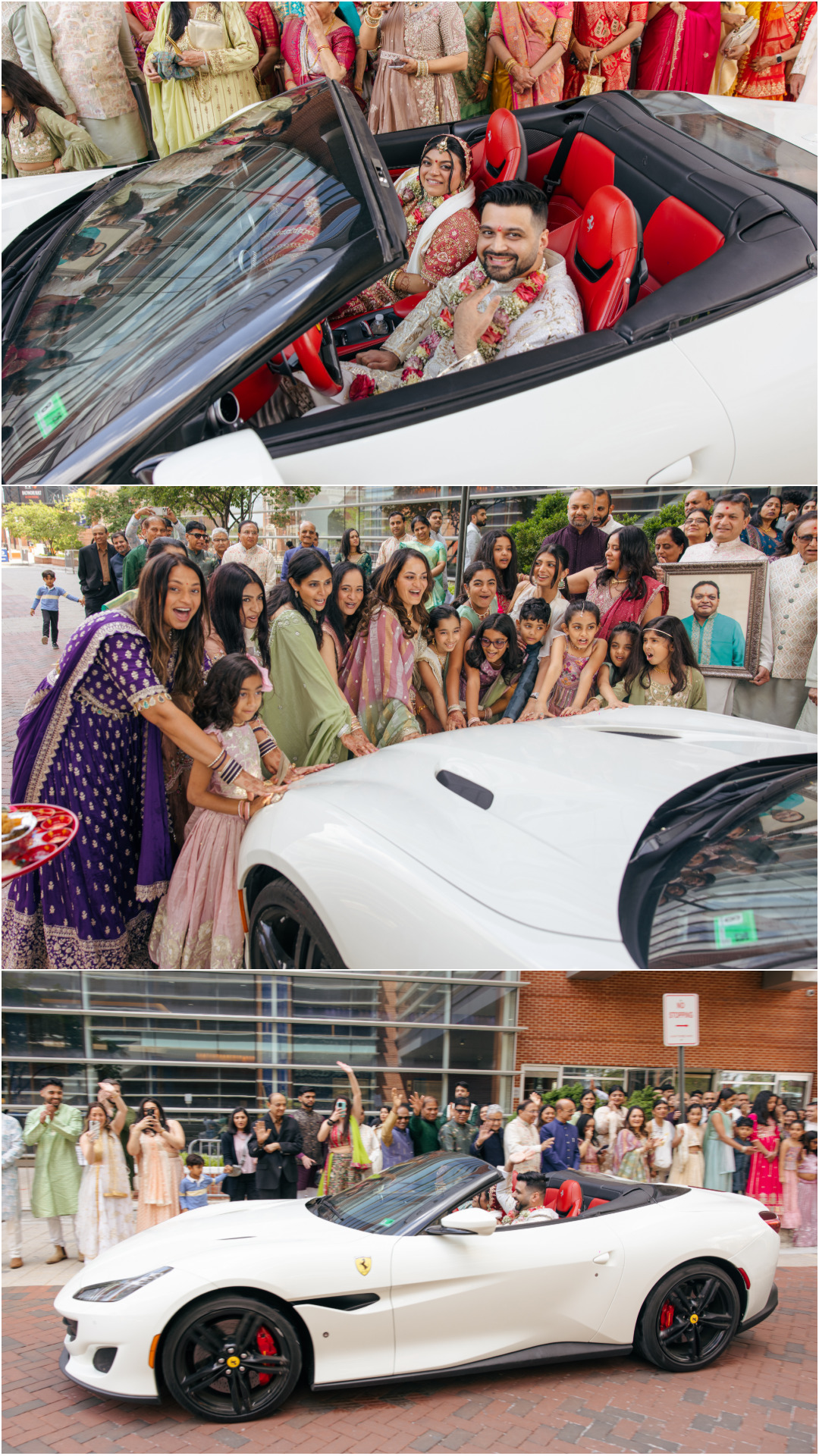
If you’ve never witnessed a Baraat — the groom’s celebratory procession — imagine a moving dance party escorting the groom to his wedding, powered by a dhol drummer and pure adrenaline. Saifin’s Baraat staged outside the Hilton, with downtown Baltimore as the backdrop: family dancing on the plaza, the dhol echoing off the glass towers, passing Baltimoreans stopping to cheer, and Camden Yards standing watch across the street.
Urban Baraats are a photographer’s dream and a logistical puzzle. Our tips for couples planning one at a downtown Baltimore wedding venue:
- Coordinate the route and timing with the hotel’s event team in advance
- Budget 45–60 minutes — Baraats never run short, and you don’t want to rush the arrival
- Position photographers ahead of the procession, not inside it, so the wide “wall of dancing family” frames are possible
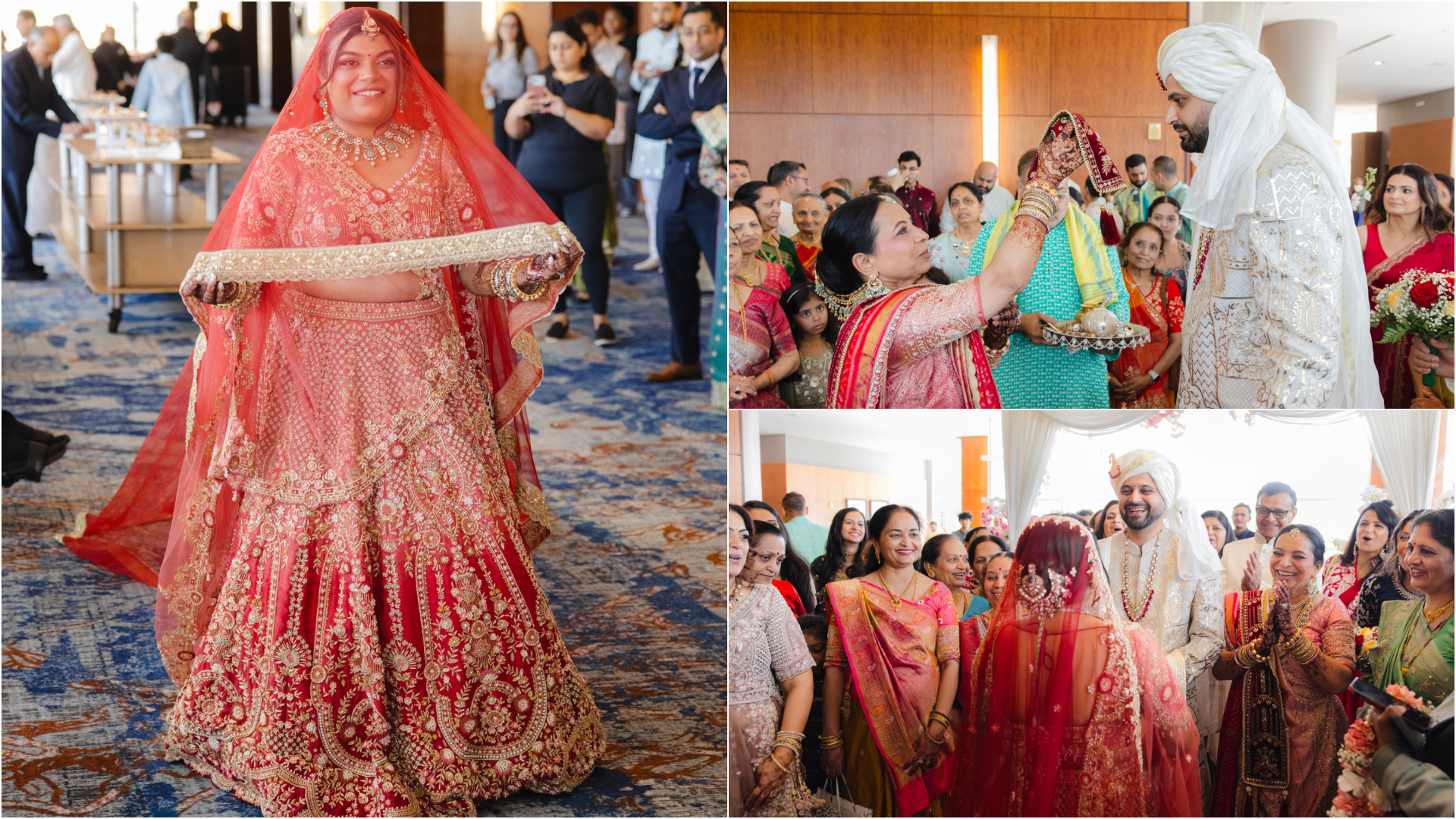
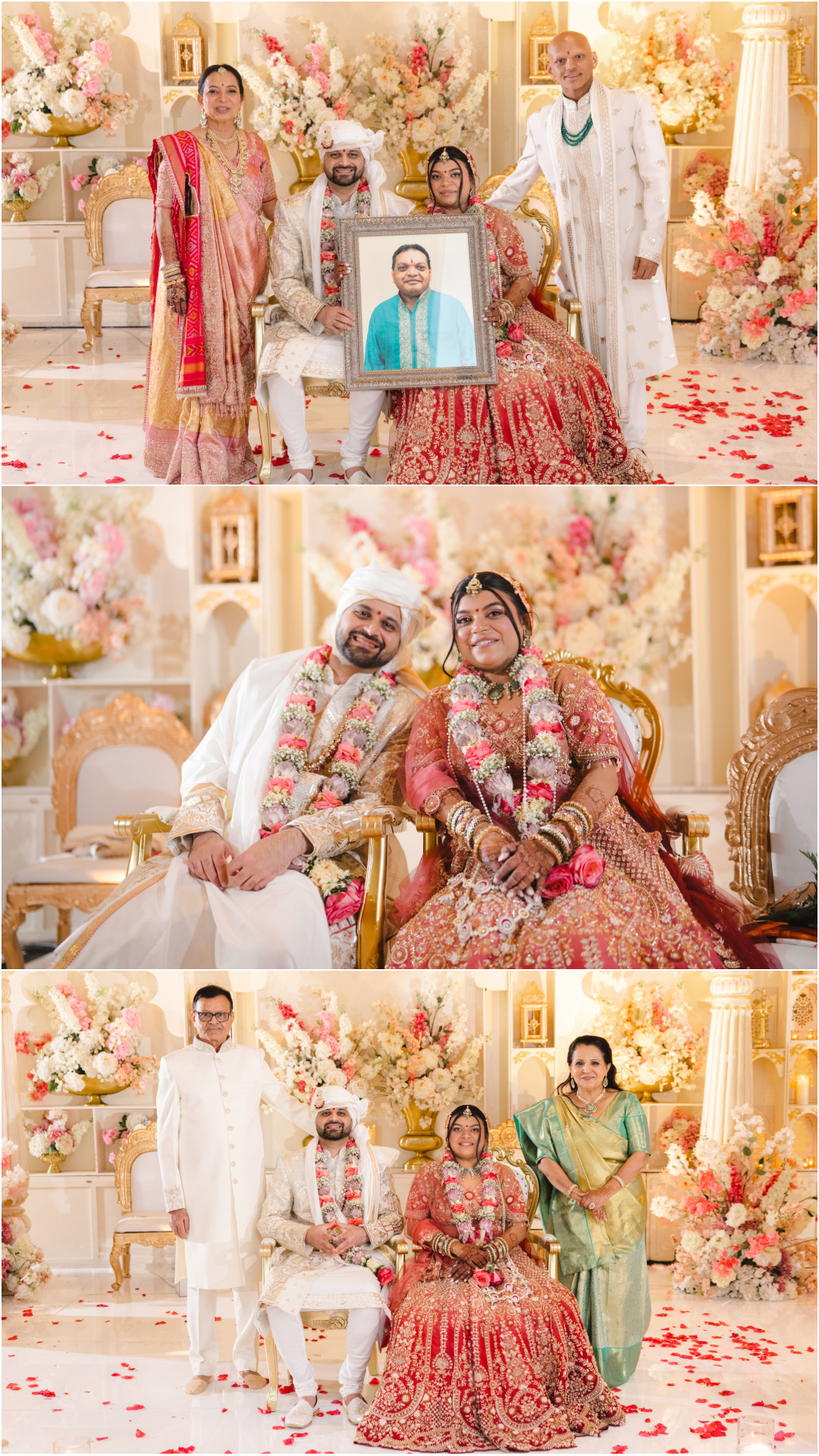
The Baraat ended at the ballroom doors, where Dhara’s family welcomed Saifin with the milni — garlands, embraces, and playful negotiations between the two families that had everyone laughing before the ceremony’s first sacred word.
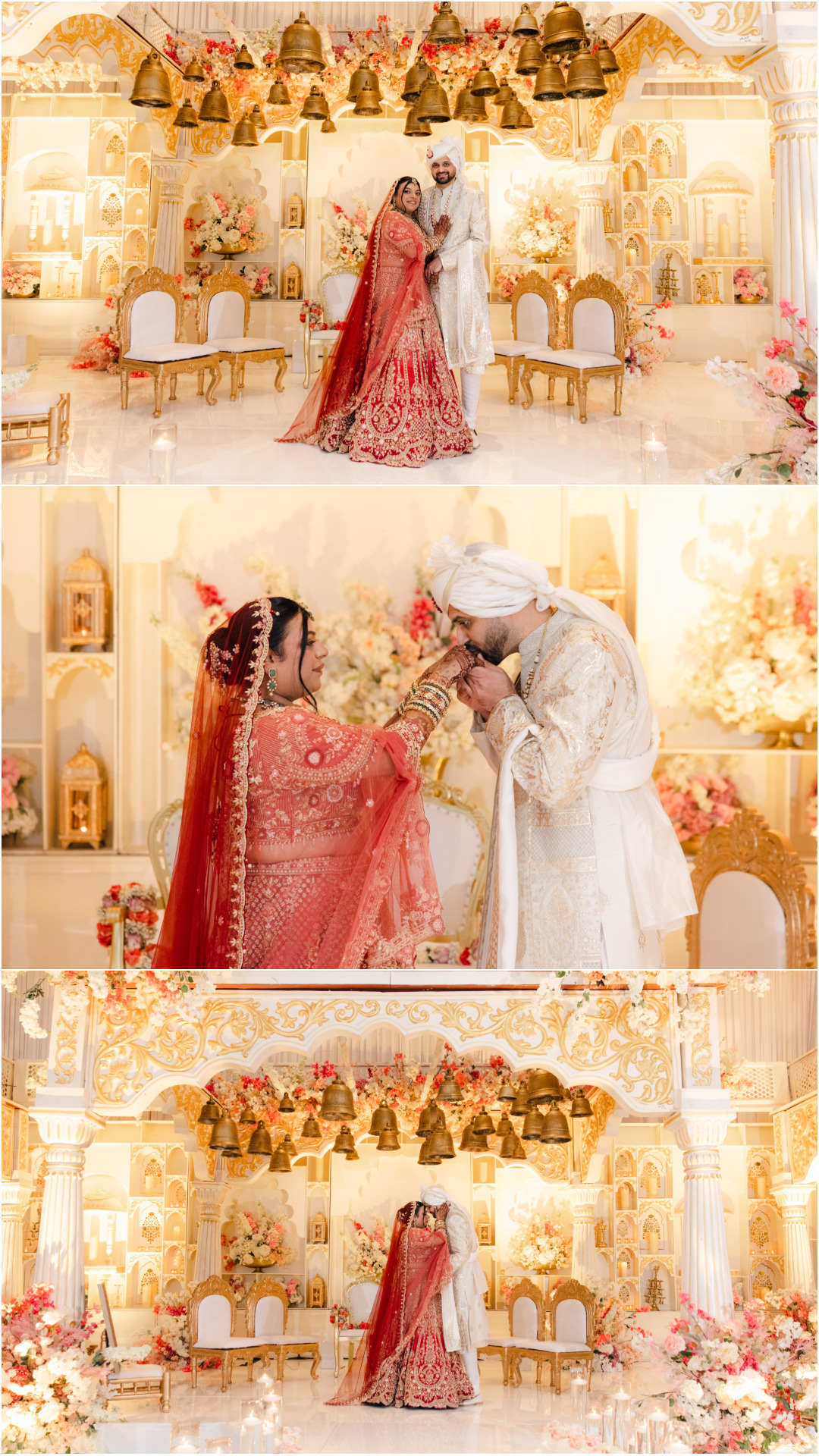
The Mandap: Ceremony Decor at the Hilton
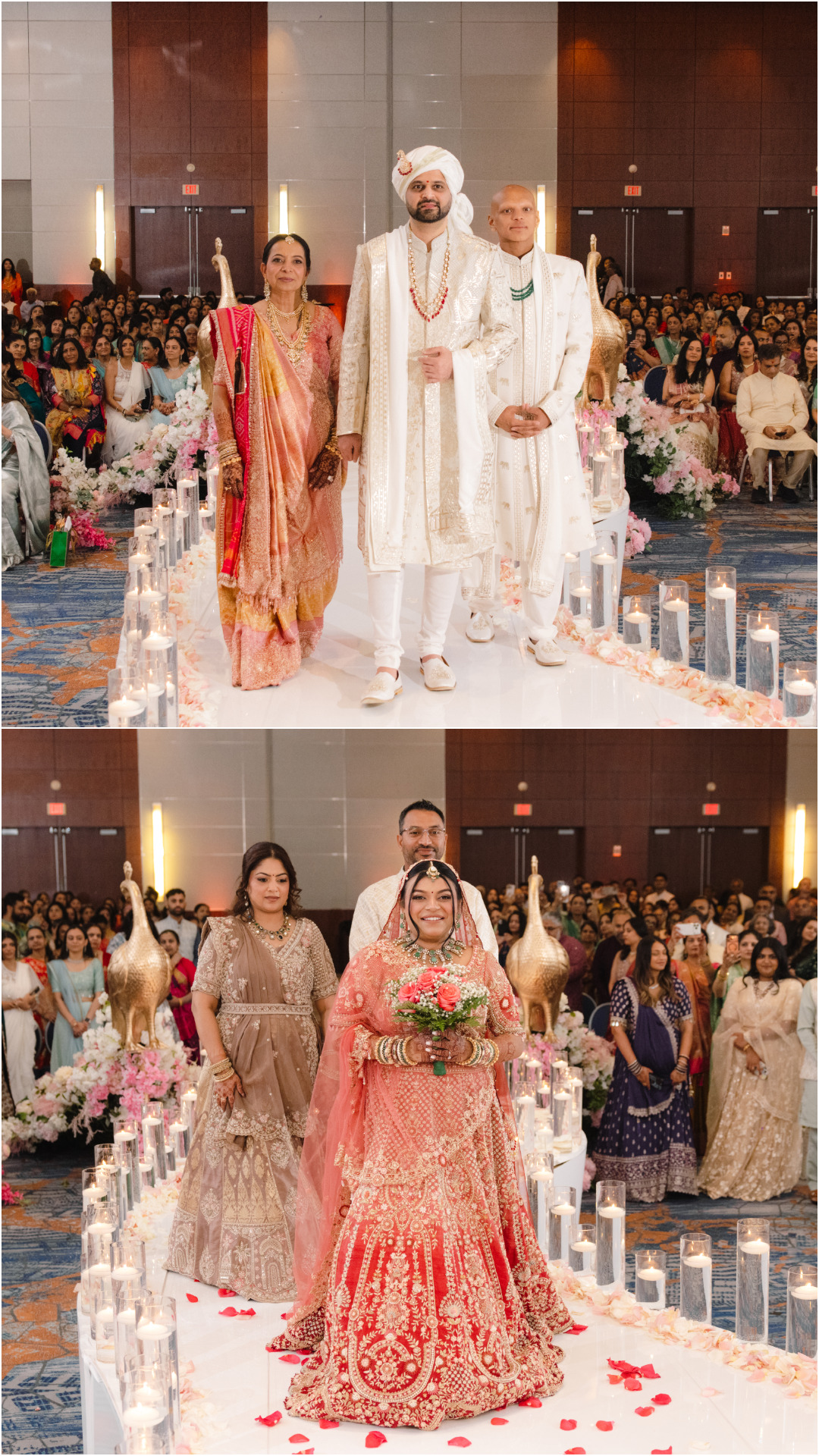
Inside, the ballroom had become a temple. The mandap — the four-pillared canopy under which Hindu wedding ceremonies take place — stood draped in ivory and blush florals with gold accents, framed by the ballroom’s soaring ceilings. Rows of guests in silk and color stretched back into the room. This is what people mean when they search for a luxury Indian wedding in Baltimore; scale and sacredness in the same frame.
The Bride’s Entrance
Dhara entered beneath a phoolon ki chadar — a canopy of flowers carried by her brothers and cousins — to live instrumental music. We shoot bridal entrances with two angles always: one photographer on Dhara’s face, one on Saifin’s. His expression when he saw her is not something we can describe better than the photograph does. That’s rather the point of hiring us.
The Rituals: Varmala, Kanyadaan, Saat Phere, Sindoor & Mangalsutra
For readers unfamiliar with a Hindu wedding ceremony, here is what unfolded under the mandap — and why each moment matters to a photographer:
- Varmala (Jaimala): The exchange of floral garlands, the couple’s first ritual act as bride and groom. Tradition invites playfulness — Saifin’s friends lifted him just out of Dhara’s reach, and the room roared. We shoot this wide for the laughter and tight for the moment the garland lands.
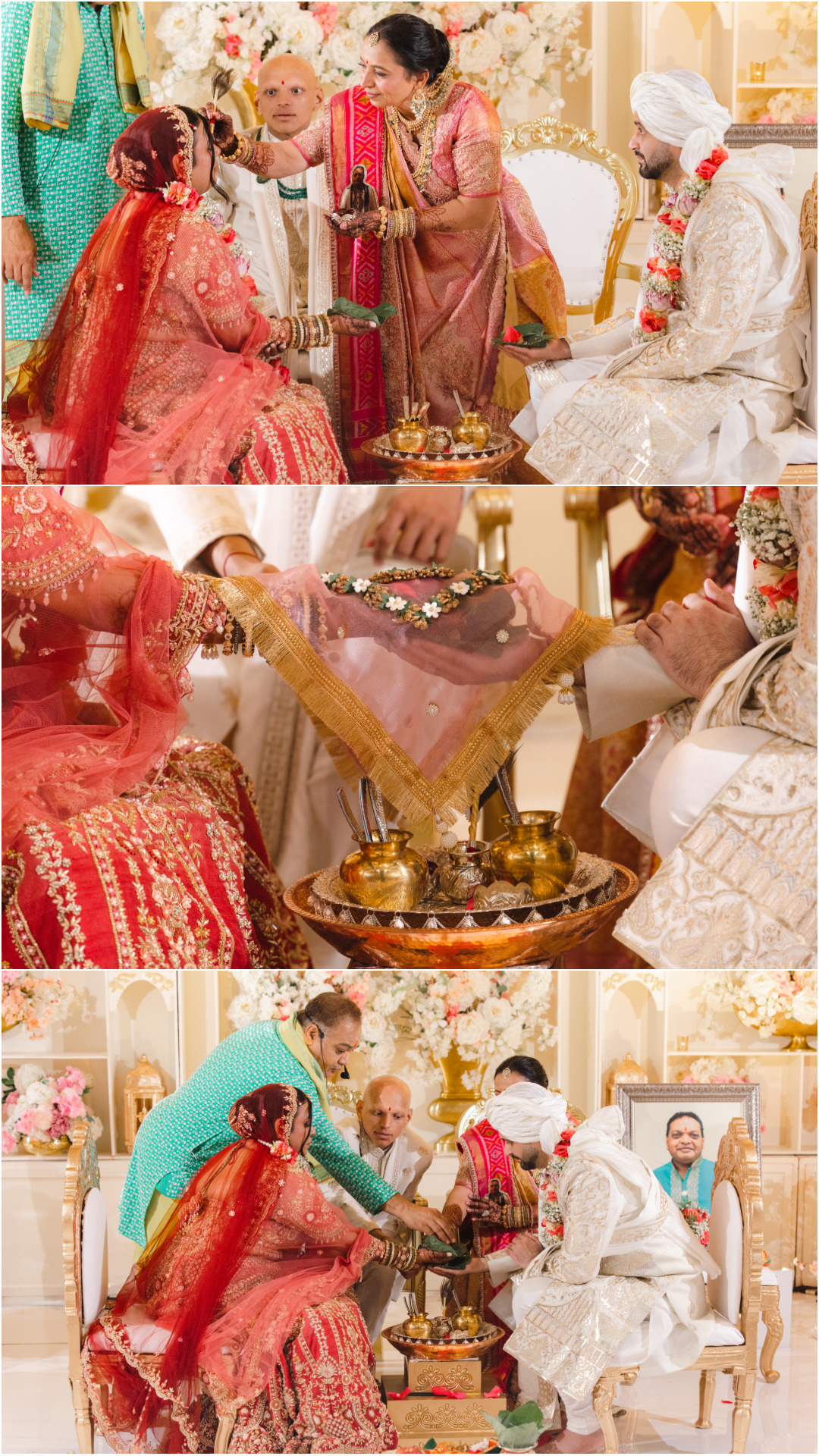
- Kanyadaan: Dhara’s parents giving their daughter’s hand in marriage — widely considered the most emotional ritual of the ceremony. We photograph hands here: her father’s hand over hers, hers over Saifin’s, the priest’s blessing above all three.
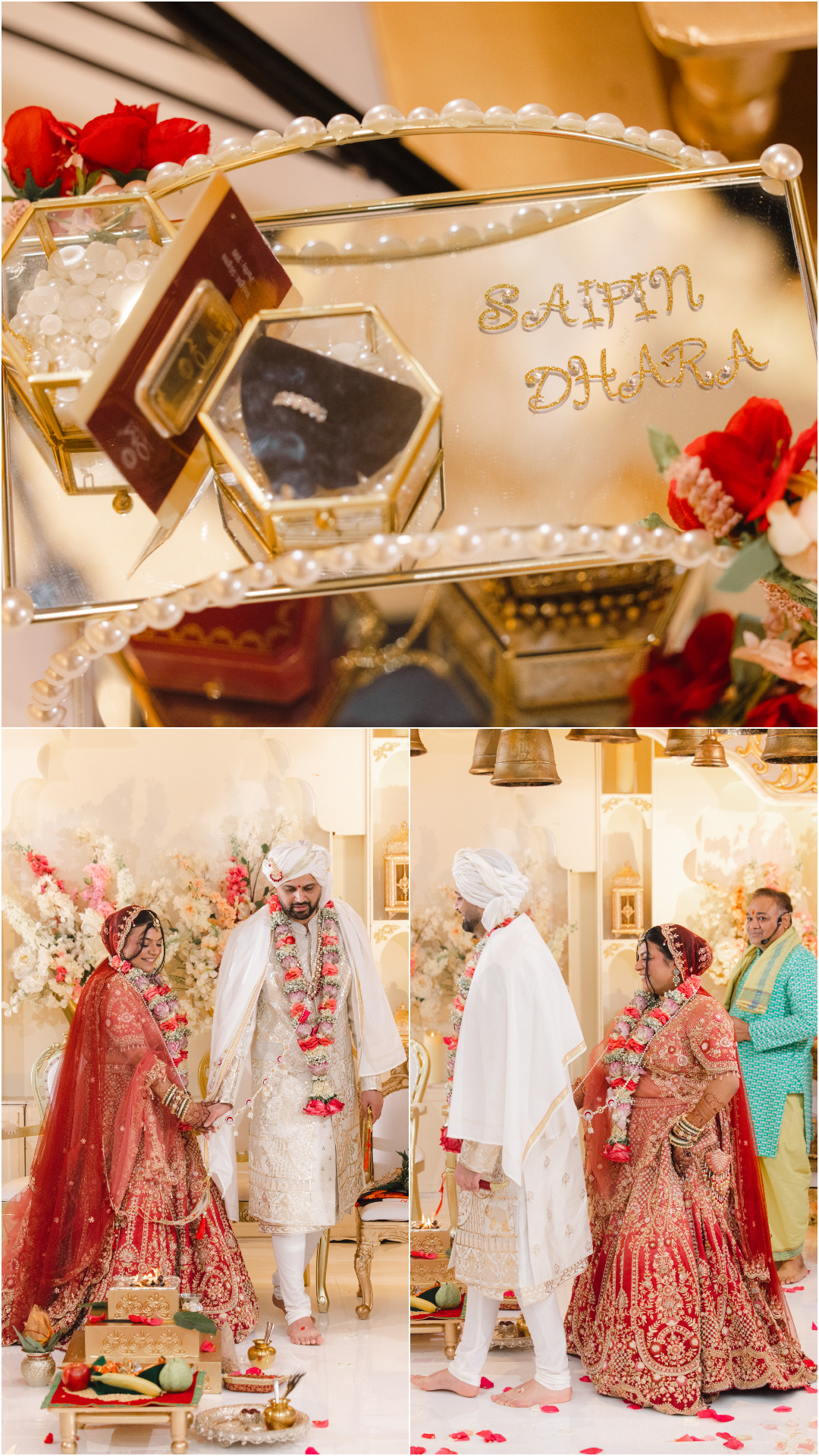
- Saat Phere (the Seven Circles): The couple circles the sacred fire seven times, each round representing a vow — nourishment, strength, prosperity, family, harmony, health, and lifelong friendship. The fire’s glow is challenging, beautiful light; we expose for the flames and let the mandap go softly warm around them.
- Sindoor: Saifin applying vermilion to the parting of Dhara’s hair — the mark of a married woman. A hush falls over the room every single time. We shoot it close.
- Mangalsutra: The sacred necklace tied by the groom, sealing the marriage. Dhara’s eyes closed as he fastened it. Her mother’s did too.
Between rituals, we worked the room for candid ceremony photography: grandmothers mouthing the mantras along with the priest, Saifin’s father wiping his eyes and pretending he wasn’t, small cousins asleep across two chairs, aunties narrating everything to each other in delighted whispers. A wedding ceremony isn’t only what happens at the mandap — it’s what happens to everyone watching it.
Ceremony Photography Tips: Light, Position, and Respect
Practical guidance from our years photographing Hindu ceremonies, for couples evaluating wedding ceremony photography in Baltimore:
- Ask your venue about lighting the mandap. The Hilton’s team worked with the decorators to keep warm, even light on the mandap — the difference between glowing ceremony photos and muddy ones.
- Hire photographers who know the rituals. A photographer who can anticipate the sindoor moment captures it; one who’s guessing misses it. There are no retakes in a wedding ceremony.
- Two photographers, minimum. One holds the ritual angle; one lives with the families. Both stories matter.
- Discuss movement with your priest beforehand. We always introduce ourselves to the pandit and agree on where we can and cannot stand. Respect for the ceremony always comes first — great photos follow from it, never at its expense.
When the final blessings were given and flower petals rained over the newlyweds, the ballroom erupted. Dhara and Saifin were married — and downtown Baltimore was waiting outside for portraits.
Golden Hour Portraits: Newlyweds and the Baltimore Skyline
Between the ceremony and reception, we stole Dhara and Saifin away for the session we’d been planning since our first timeline call: golden hour portraits around the Inner Harbor.
When should golden hour portraits happen? Roughly the final 60–90 minutes before sunset, when the light turns warm, low, and impossibly flattering. We build every wedding timeline backward from this window. For this wedding, that meant a 25-minute session split between the harbor promenade — sailboats, water, and that soft coastal light — and the hotel’s architectural lines back on Pratt Street.
Dhara in deep red against the blue of the harbor at dusk is the kind of color contrast photographers dream about. These are the wedding photos at Hilton Baltimore Inner Harbor that couples find when they’re researching this venue — and now Dhara and Saifin’s are among them.
Our advice to future couples: protect this window fiercely. Twenty-five focused minutes of couple portraits at golden hour will outperform two rushed hours at any other time of day.
Event 4 — The Reception: The Key Ballroom Comes Alive
A Ballroom Transformed
By evening, the ballroom had shed its ceremonial ivory for full glamour: candlelit tables, towering floral centerpieces in burgundy and blush, gold-rimmed place settings, uplighting that turned the walls to amber, and a monogrammed dance floor bearing Dhara and Saifin’s initials. If the ceremony was sacred, the reception was cinematic — exactly the tonal shift a great luxury Indian wedding reception should deliver.
We always arrive in the ballroom before doors open to photograph reception decor untouched: the full room from the entrance, the head table styled and lit, each centerpiece, the cake, the stationery. Your planner and decorators build this room for a matter of hours; these photographs are how their artistry survives the party.
The Grand Entrance
Dhara and Saifin entered to a roar — she in a shimmering evening gown-style lehenga, he in a sharp black tuxedo, both entirely transformed from the morning. Their entrance rolled straight into a choreographed opening number with the wedding party, and the reception’s energy never dipped from that moment forward.
Photography note: we light grand entrances with off-camera flash placed ahead of the couple’s path, so their faces are lit and the ballroom’s ambiance stays moody behind them. Reception lighting is where professional equipment and experience visibly separate the results — dark ballrooms are unforgiving to guesswork.
First Dance, Cake, and Speeches
Their first dance began slow and sincere under a single spotlight and ended — because of course it did — with a beat-drop into full choreography that brought the room to its feet. The cake cutting followed, a five-tier design echoing the mandap florals.
Then came the speeches: Dhara’s sister mixing childhood blackmail material with genuine tears, Saifin’s best friend recounting the “just to continue the conversation” coffee that started it all, and both sets of parents offering blessings that left very few dry eyes in a 300-person ballroom. During speeches, one photographer stays on the speaker and couple; the other watches the crowd. The reaction shots — Dhara laughing into Saifin’s shoulder, a grandmother dabbing her eyes — are half the story.
The Dance Floor
What followed was four hours of what Indian wedding receptions do best. Bollywood, bhangra, Top 40, a dhol player joining the DJ, a surprise family dance-off, and a dance floor that at several points appeared to contain every single guest simultaneously — grandparents included.
Late-night reception photography is a craft of its own: we mix flash with slow shutter drags to keep motion and energy in the frames, so the photos feel the way the night felt. Crisp, frozen, flash-blasted party photos lie about the atmosphere. Ours don’t.
Night Portraits & the Grand Exit
Near midnight, we took the newlyweds outside one last time for night portraits — the Hilton’s glowing facade and the downtown Baltimore lights behind them, a quiet ten minutes that they later told us felt like the first time all day they’d simply stood still together. Build this pause into your timeline. You will thank yourself.
The night closed with a sparkler send-off, Dhara and Saifin running through a tunnel of light held by everyone they love. Final frame of the weekend. Perfect one.
Photography Highlights & Favorite Moments of the Weekend
If we had to hand-pick the frames we’ll remember from this Hilton Baltimore Inner Harbor wedding:
- Dhara’s mother going silent at the first sight of her daughter in bridal wear
- The first fistful of haldi and the eruption that followed
- Saifin’s face during the bridal entrance
- Her father’s hands during the Kanyadaan
- Golden hour on the Inner Harbor promenade
- Three generations dancing to the same dhol at the reception
- The sparkler exit through downtown Baltimore’s midnight glow
Advice for Future Couples: Planning & Photography Timeline Tips
After hundreds of South Asian weddings, here’s the practical guidance we’d give any couple planning a luxury Indian wedding in Maryland or the DC–Baltimore corridor:
- How many hours of photography coverage do couples need? For a multi-day Indian wedding, plan on 6–8 hours for the Mehndi and Haldi combined, and 10–14 hours for the wedding day (getting ready through reception). Single-event weddings typically need 8–10 hours.
- How many photographers should couples hire? Two, minimum — and for guest counts above 300 or simultaneous events, three. One camera cannot cover a Baraat, a bride’s entrance, and two families’ reactions at once. Nobody can be in two places; two photographers can.
- Should couples schedule a first look? For Indian weddings, we often recommend a modified approach: keep the traditional entrance reveal for the ceremony, and use golden hour after the ceremony as your dedicated couple session. If your ceremony runs late in the day, a first look protects your portrait time.
- How much time should you allow for portraits? 45–60 minutes total across the day: details and getting ready, family formals (with a printed shot list — non-negotiable), and 25–30 protected minutes of couple portraits.
- Build the timeline around light, not around habit. Golden hour, ceremony lighting, and reception ambiance are decided months in advance by your schedule. Involve your photographer in timeline planning early.
- What moments should never be missed? The first-sight reactions (parents seeing the bride, groom seeing the bride), Kanyadaan hands, Sindoor, Mangalsutra, the parents’ speeches, and the last dance. Tell your photographer what your non-negotiables are — every family has their own.
Why Professional Wedding Photography Matters
Flowers fade, the food is eaten, the music ends at midnight. Photographs are the only vendor deliverable that appreciates over time. A professional team brings ritual fluency, backup equipment, lighting expertise for dim ballrooms and dark dance floors, and — most importantly — the anticipation that comes from having seen a thousand sindoor moments and still treating yours as the only one that matters.
Why Shan Photography Loves Photographing Weddings in Baltimore
Baltimore gives us everything we want as wedding storytellers: waterfront light at the Inner Harbor, historic texture in Federal Hill and Fell’s Point, big-city architecture downtown, and venues like the Hilton Baltimore Inner Harbor that can genuinely host a full-scale, multi-day South Asian celebration. Though our roots are in Chicago, our team travels nationwide for Indian, Pakistani, Sikh, Muslim, Hindu, and fusion weddings — and Maryland, Washington DC, Virginia, Pennsylvania, and New Jersey couples are a growing part of our story. You can explore all the regions we serve on our locations page.
Final Thoughts
Dhara and Saifin’s wedding weekend was three days of color, faith, family, and joy in the heart of Baltimore — proof that the Hilton Baltimore Inner Harbor isn’t just a place to hold an Indian wedding, but a place where one can truly come alive. Thank you, Dhara and Saifin, for trusting us with your story.
Ready to Plan Your Own Baltimore Wedding?
If you’re planning an Indian, South Asian, fusion, or luxury wedding in Baltimore, Maryland, or anywhere in the DC metro region — we would love to hear your story. Explore more real weddings on our blog, browse our Indian wedding photography portfolio and cinematic wedding films, learn more about our team, or contact Shan Photography today to check your date. Your wedding deserves to be remembered exactly the way it felt.
Frequently Asked Questions
Is the Hilton Baltimore Inner Harbor a good wedding venue?
Yes — it’s one of Maryland’s best large-capacity wedding venues. Located at 401 W Pratt St in downtown Baltimore, it offers expansive ballrooms, multiple event spaces for multi-day celebrations, on-site guest rooms, and a location steps from the Inner Harbor and Camden Yards.
Can Indian weddings be hosted at the Hilton Baltimore Inner Harbor?
Absolutely. The hotel accommodates mandap installations, Baraat processions, multi-day events like Mehndi and Haldi, and guest counts in the hundreds — as Dhara and Saifin’s weekend proved.
What makes this venue special for South Asian weddings?
Scale and convenience. Every event happens under one roof, out-of-town guests stay on-site, and the ballrooms are large enough for a mandap, stage, dance floor, and 300+ seated guests without compromise.
Where are the best wedding portrait locations near the Hilton Baltimore Inner Harbor?
The hotel’s window-lit suites and glass architecture, the Inner Harbor promenade (5 minutes away), Federal Hill Park for skyline views, and the streetscape near Camden Yards.
What is a Hilton Baltimore Inner Harbor wedding like?
Grand, convenient, and distinctly Baltimore — ballroom luxury inside, waterfront and skyline portraits outside, with the energy of downtown all around.
How much photography coverage do couples need for an Indian wedding?
Typically 10–14 hours on the wedding day and 3–4 hours per pre-wedding event (Mehndi, Haldi, Sangeet). Multi-day packages are the norm for South Asian weddings.
How many photographers should we hire?
At least two. Indian weddings unfold in multiple places at once — a single photographer must choose between the Baraat and the bride, between the ritual and the reactions. Two photographers choose both.
Should we do a first look?
If your ceremony ends before golden hour, you can skip it and use post-ceremony light for portraits. If your ceremony runs into the evening, a first look protects your couple-portrait time. We help every couple decide based on their specific timeline.
How much time should we set aside for couple portraits?
25–30 protected minutes at golden hour produces more keeper images than two scattered hours at midday. Add 20–30 minutes for family formals with a prepared shot list.
What season is best for a Baltimore wedding?
Late spring (May–June) and early fall (September–October) offer the most comfortable weather and the best harbor light. That said, the Hilton’s indoor spaces make it a genuinely year-round venue — winter ballroom weddings there are stunning.
When should golden hour portraits happen?
In the last 60–90 minutes before sunset. Your photographer should build the timeline backward from this window during planning.
What Indian wedding moments should never be missed by a photographer?
Parents seeing the bride for the first time, the groom’s reaction at the entrance, Kanyadaan, Saat Phere, Sindoor, Mangalsutra, the milni, and the parents’ speeches.
Does Shan Photography travel for weddings?
Yes — we photograph weddings nationwide and internationally, with teams serving Baltimore, Washington DC, New York, and beyond. Travel is built into our multi-day wedding packages. See our locations or destination wedding portfolio.
Does Shan Photography offer videography as well?
Yes — our team produces cinematic wedding films alongside photography, so your coverage is seamless and coordinated. Watch examples on our Indian wedding films page.
How far in advance should we book a wedding photographer in Baltimore?
For peak-season and multi-day Indian weddings, 9–14 months in advance. Popular dates at venues like the Hilton Baltimore Inner Harbor book quickly.
Can the Mehndi and Haldi be photographed at the same venue as the wedding?
Yes, and we strongly recommend it when possible. Single-venue weekends save hours of transit time — hours that become extra portraits, extra candids, and extra celebration.
What should guests wear to a Mehndi or Haldi?
Mehndi: vibrant festive colors. Haldi: yellow and gold (and nothing you’d mourn if turmeric finds it — it will).
How do photographers handle dark ballroom receptions?
With professional off-camera lighting, fast lenses, and experience. Reception lighting design is one of the clearest differences between professional and amateur wedding photography.
How soon do couples receive their photos?
Timelines vary by package; we deliver sneak peeks quickly after each event and full galleries within the timeframe promised in your contract. Ask us for current turnaround details when you inquire.
Follow & Connect with Shan Photography
- Website: https://www.shanphotography.com/
- Facebook: https://www.facebook.com/photographybyshan/
- Instagram: https://www.instagram.com/shanphotographyinc/