

Your wedding day moves fast. One moment you’re getting ready, and the next, your guests are dancing at the reception. It’s a whirlwind — and no matter how carefully you planned every detail, you can’t pause time to soak it all in.
That’s exactly why wedding photo editing matters so much. The photos are where time stops. They’re how you’ll relive the look on your partner’s face, the tears in your mother’s eyes, and the joy in that first dance. The editing process is what transforms thousands of raw moments into a polished, cohesive visual story you’ll treasure for generations.
This guide covers everything you need to know — from understanding the difference between basic editing and high-end retouching, to choosing a photography style that fits your personality, to knowing what to expect from your photographer’s post-production workflow.
Editing vs. Retouching: What’s the Real Difference?
This is one of the most common questions couples ask, and it’s a great one. These two terms often get used interchangeably, but they describe very different stages of the post-production workflow.
Standard Editing: The Foundation Every Photo Needs
Think of standard editing as the process of making your photos look the way the moment actually felt. Your photographer shoots in RAW files — large, uncompressed image files that capture significantly more data than a standard JPEG. These RAW files need to be processed before they can be shared or printed.
Standard editing includes:
- Color correction — Adjusting the temperature and tint so skin tones look warm and natural, not green or orange under venue lighting
- Exposure adjustment — Brightening shadows or pulling back highlights so details aren’t lost in bright outdoor shots or dark ballroom settings
- White balance — Ensuring the whites in your dress actually look white, whether you’re in warm golden-hour light or under indoor venue lighting
- Contrast and clarity — Adding depth and dimension so photos don’t look flat
- Cropping and straightening — Refining composition to guide the viewer’s eye
Every single image in your gallery goes through this process. For a full wedding day, that could be 800 to 1,500 photos or more.
Professional Retouching: The Final Polish
Retouching is a higher level of attention applied to specific images — usually your portraits, detail shots, and hero images (the ones that will be framed, printed large, or featured in albums). This is what the industry calls professional wedding photo enhancement: going beyond basic corrections to make select images truly gallery-worthy.
Professional wedding photo retouching includes:
- Skin smoothing — Softening temporary blemishes, redness, or uneven texture without making skin look plastic or airbrushed
- Distraction removal — Taking out that exit sign in the corner of your ceremony shot, the stray hair across your face in a portrait, or the half-eaten dinner plate in the background
- Eye brightening — Subtle enhancement so eyes look clear and expressive, especially in candid emotional moments
- Flyaway hair cleanup — Especially important for outdoor shoots where wind is a factor
- Background cleanup — Removing temporary distractions like a dropped napkin or an unsightly cable
The goal is always a natural look. You want to look like you on your absolute best day — not a filtered, over-processed version of yourself. Good retouching should be invisible. If you can tell someone was retouched, it went too far.
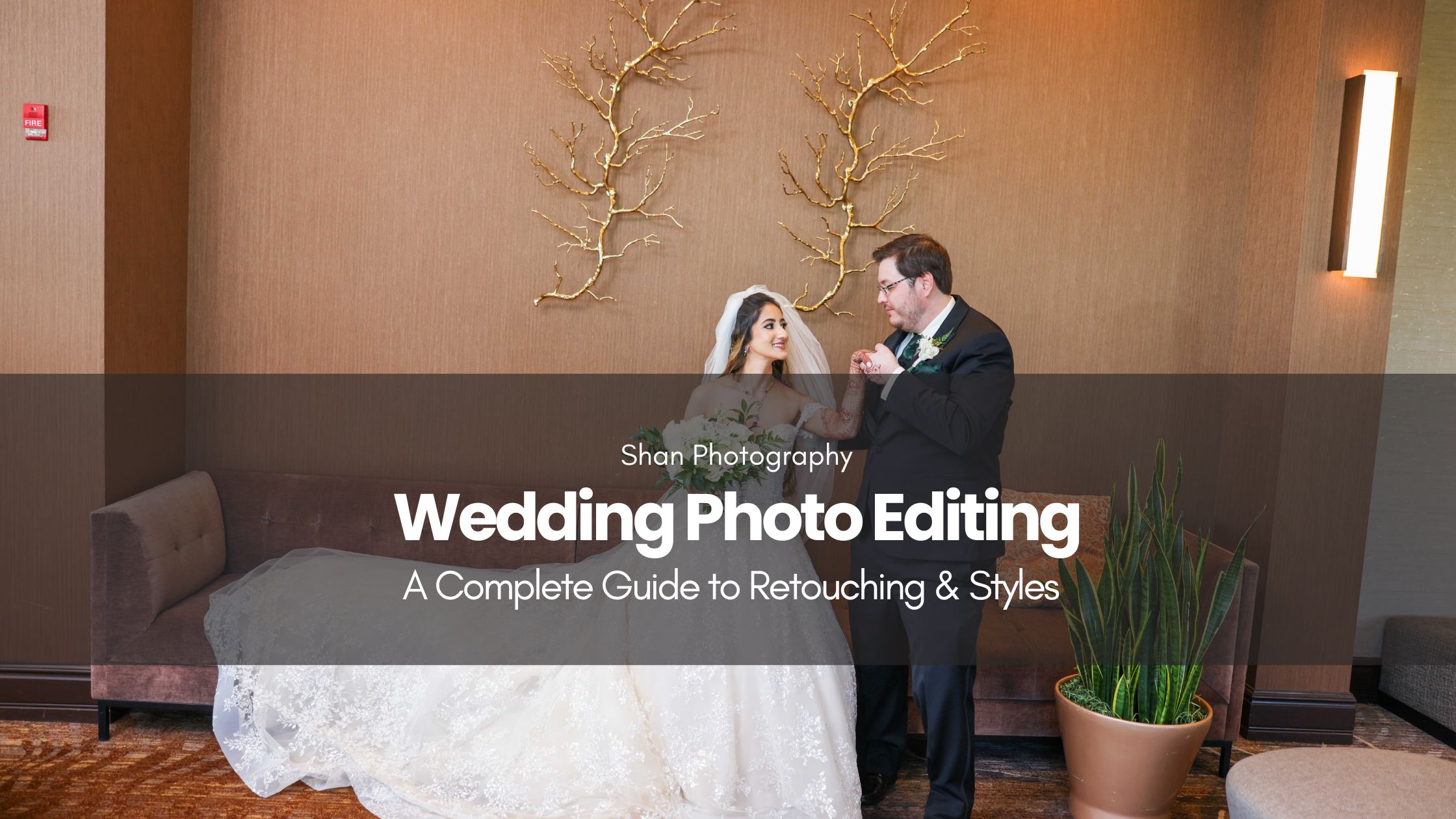
Finding Your Aesthetic: Popular Wedding Photography Styles
Before you book a photographer, it helps to know what visual style speaks to you as a couple. These are the four most popular wedding photography editing styles, and each creates a completely different emotional experience when you look back at your gallery.
Cinematic & Timeless
This style draws inspiration from film photography and classic cinema. Think rich, deep colors, slightly crushed shadows, and a mood that feels like a frame from a beautifully made film.
- Colors are intentional and slightly desaturated for a timeless quality
- Skin tones are warm and golden
- Images feel dramatic without being over-edited
- Works beautifully for couples who want their photos to feel classic decades from now
- Ideal for venues with character — grand ballrooms, historic estates, or ceremony spaces with architectural detail
Cinematic wedding photography editing works especially well when the richness of fabrics, florals, and ceremony details deserve a color palette that honors them — not flattens them. This style is particularly striking for weddings with a lot of visual depth and layering, like South Asian celebrations where the textures and colors of attire and decor are central to the story.
Light & Airy
The light and airy aesthetic has an effortless, romantic quality that photographs beautifully.
- Bright, lifted shadows and soft highlights
- Pastel tones and a dreamy, washed-out feel
- Works exceptionally well for outdoor daytime weddings
- Great for venues with abundant natural light — garden ceremonies, barn venues, or open-air spaces
One thing to keep in mind: this style can sometimes struggle in low-light or dark reception settings. Ask your photographer how they handle mixed lighting environments before you fall in love with the look.
Dark & Moody
For couples who love drama, intimacy, and a more editorial feel, dark and moody editing delivers.
- High contrast with deep, rich shadows
- Earthy, muted tones — burgundy, forest green, navy
- Evocative and romantic, with a film noir quality
- Works beautifully for evening receptions, candlelit ceremonies, and intimate venues
This style tends to look stunning for couples who gravitate toward editorial fashion photography aesthetics in their everyday lives.
True-to-Life / Natural Wedding Photography
Some couples simply want their photos to look exactly the way the day felt — no particular mood or filter applied. This is what most people mean when they search for natural wedding photography styles: clean, accurate color reproduction that reflects reality without heavy grading.
- Accurate skin tones and true whites
- Vibrant but not oversaturated color
- Bright and cheerful without being washed out
- Versatile across all lighting conditions and venue types
This style works well for any wedding where you want the colors of your florals, attire, and decor to look exactly as they were — vivid, true, and real.
Behind the Scenes: The Post-Production Workflow
Most couples see the final gallery and have no idea how much work went into getting it there. Here’s an honest look at what happens between the last dance and the day your photos arrive.
Step One: Culling — Choosing the Best Shots
After a full wedding day, a photographer can come home with anywhere from 3,000 to 6,000 RAW files. Image culling is the art of carefully reviewing every single one and selecting only the best — sharp focus, great expressions, flattering angles, meaningful moments.
This process alone can take four to eight hours for a full wedding day. It requires artistic judgment, not just technical review. The goal is to deliver a gallery where every image earns its place.
Step Two: Applying a Consistent Look
Once the selects are chosen, the real artistry begins. A skilled photographer applies a consistent signature style across all 800 to 1,000+ images so your gallery tells a cohesive story — not a collection of random shots.
- Every image in the same location feels visually connected
- The ceremony, cocktail hour, and reception flow naturally from one to the next
- Skin tones remain consistent whether you’re indoors under artificial light or outside in open shade
This is what separates a professional photographer’s gallery from a collection of individual shots edited one at a time. It’s the difference between a story and a slideshow.
Step Three: High-End Retouching for Portrait & Hero Shots
The final stage is deep retouching for your portraits and the standout images from your day. These are the shots most likely to be printed, framed, or featured in your wedding album — so they deserve extra attention.
This is where skin smoothing, distraction removal, and careful detail work come in. It’s painstaking, image-by-image work, and it’s one reason quality post-processing takes as long as it does.
How Long Does Wedding Photo Editing Take?
This is one of the most searched questions couples have after their wedding, so let’s answer it directly.
Typical turnaround time: 6 to 12 weeks.
That might feel long if you’re eager to see your photos, but here’s the reality: editing 800 to 1,200 wedding photos to a professional standard is not a one-click filter situation. It is entirely manual, artistic work done image by image.
Here’s what’s included in that timeline:
- Backing up and organizing all RAW files (done immediately after the wedding)
- Culling 3,000+ images down to the best 800 to 1,200
- Color correcting and applying the signature editing style to every selected image
- High-end retouching for portraits and hero shots
- Quality review of the full gallery
- Exporting and uploading in both web-resolution and print-ready formats
What About Sneak Peeks?
Many photographers will deliver a small set of edited sneak peek images within a few days of your wedding — usually 10 to 30 images. These give you something to share with family and post to social media while the full gallery is being completed. They also give you an early look at the editing style applied to your specific wedding day, lighting, and venue.
What Affects the Turnaround Time?
- Season — Peak wedding season means busier post-production schedules. If your wedding falls in spring or fall, expect photographers to be working through several galleries at once
- Album orders — A custom wedding album adds additional design and approval rounds on top of the standard turnaround time
- Wedding complexity — A multi-day celebration with several ceremonies involves significantly more images than a single-day event and naturally takes longer to edit
Always ask your photographer about turnaround time before booking, and get it in writing in your contract. A clear turnaround time in your agreement protects both of you.
Questions to Ask Your Photographer About Editing
When you’re meeting with photographers, don’t just look at their images — ask about their process.
About Their Style
- Can I see a full gallery from a recent wedding, not just portfolio highlights?
- How would you describe your editing aesthetic?
- Do you ever adjust your signature style based on a couple’s preferences?
About Retouching
- What does your standard retouching include?
- Do you offer additional retouching for album images?
- Will you remove environmental distractions like signs and background clutter?
About the Workflow
- What format will my final images be delivered in?
- Will I receive both web-resolution and print-ready files?
- Do you offer sneak peeks, and how soon after the wedding?
About Timelines
- What is your expected turnaround time for my wedding date?
- Will this be clearly stated in my contract?
A photographer who welcomes these questions and answers them clearly is one who takes their craft — and your investment — seriously.
Does Wedding Photo Editing Style Matter for Cultural Celebrations?
Yes — and this is worth understanding before you book.
Weddings with rich visual traditions require extra care during the post-production workflow. The deep reds and magentas of a South Asian bridal lehenga, the intricate gold embroidery of a sherwani, the vibrant florals adorning a mandap — these colors can easily shift or clip if color correction isn’t handled with precision and cultural awareness.
The same applies to other culturally rich celebrations: the bold color palettes of Nigerian traditional ceremonies, the soft florals of a classic Western church wedding, or the layered textures of a Jewish or Greek Orthodox celebration. Every tradition has its own visual language, and a photographer’s post-production workflow should honor that.
When you’re evaluating photographers, look at galleries from weddings similar to yours — not just the photography style, but the types of celebrations they’ve shot. Ask whether they have experience editing for your specific color palette and ceremony traditions.
Choosing a Vision, Not Just a Vendor
Here’s the bottom line: when you hire a wedding photographer, you’re hiring two things at once — their eye for capturing moments and their eye for editing them.
The best wedding photographers have a clear, consistent visual point of view that carries from the moment they pick up their camera to the final retouched image delivered to your gallery. Their editing style is not an afterthought. It’s as much a part of their creative identity as the way they compose a shot or direct a portrait.
So when you’re researching photographers — whether you’re drawn to a cinematic style, a light and airy feel, or natural wedding photography that keeps things true to life — pay close attention to how the finished images feel, not just how technically sharp they are.
Ask yourself: Does this gallery make me feel something? Does the style feel timeless or trendy? Does the retouching look invisible, or can I see heavy-handed skin smoothing and obvious digital manipulation?
The photographer whose gallery answers those questions the right way for you is the one worth booking.
Ready to See These Styles in Action?
Exploring different editing styles is a lot easier when you can see real examples from real weddings. Browse the Shan Photography portfolio to see how the cinematic, timeless approach translates across different venues, cultural celebrations, and lighting conditions.
Every gallery tells a story. The question is: what story do you want your wedding photos to tell?
Shan Photography specializes in South Asian and multicultural wedding photography across the United States.